Microblading Consent Form: What Clients and Pros Must Know
Discover what is microblading consent form and why it's essential for clients and pros. Ensure safe, compliant procedures today!

Microblading Consent Form: What Clients and Pros Must Know

A microblading consent form is a legally binding document that clients sign before undergoing a microblading procedure, capturing medical history, risk acknowledgments, aftercare agreements, and informed consent to protect both the client and the practitioner. Known in the industry as a permanent makeup client agreement or PMU consent form, this document is not optional paperwork. It is the foundation of safe, compliant microblading practice. Without it, practitioners face significant liability exposure, and clients proceed without fully understanding what the procedure involves.
What is a microblading consent form and what must it include?

A microblading consent form is a structured intake document covering every material fact a client needs to know before the procedure begins. The form serves three simultaneous functions: it informs the client of risks, it collects health data the practitioner needs to proceed safely, and it creates a legal record of the client’s agreement. Understanding consent forms in beauty treatments is the starting point for any professional offering permanent makeup services.
The core elements every microblading consent form must contain include:
- Client identification and age verification. Clients must be at least 18 and provide government-issued photo ID before the procedure. This is a compliance requirement, not a courtesy check.
- Medical history checklist. This section covers allergies, current medications, skin conditions such as psoriasis or eczema, autoimmune disorders, and prior reactions to pigments or anesthetics. Clients with skin conditions like eczema should delay microblading, as these affect pigment retention and healing.
- Risk disclosures. The form must clearly state risks including infection, uneven pigmentation, swelling, topical anesthesia reactions, and MRI considerations. Clients must acknowledge each risk in writing.
- Patch test documentation. The form must record whether a patch test was performed or waived. If waived, the client’s signature on that specific clause shifts allergic reaction liability to the client.
- Pre- and post-procedure care instructions. Microblading aftercare instructions belong in the consent form, not just on a separate handout. Embedding them creates a documented record that the client received and acknowledged this guidance.
- Pigment and device information. Practitioners should document pigment lot numbers and device details for insurance compliance and allergic reaction traceability. This step is required for insurance purposes and is rarely done well.
- Photography waiver. An optional but recommended clause covering whether the practitioner may photograph the client’s brows for portfolio or marketing use.
- Liability waiver and signature block. This is the microblading liability waiver component. It confirms the client has read, understood, and agreed to all disclosures.
Pro Tip: Never bury the liability waiver language at the bottom of a long form in small print. Place it in a clearly labeled section with its own signature line. Courts have rejected waivers that were not clearly presented as such.
How do microblading consent requirements vary by state?
Microblading is legally classified as tattooing in many states, which means practitioners must hold a tattoo or permanent makeup license and complete bloodborne pathogen (BBP) certification. This classification directly affects what your consent form must contain, because state tattoo regulations often specify required disclosures, recordkeeping timelines, and client verification standards.
The table below shows how requirements differ across key jurisdictions.
| Requirement | Virginia | Florida | General Standard |
|---|---|---|---|
| Minimum client age | 18 with photo ID | 18 with photo ID | 18 in most states |
| Minor consent | Parental presence or notarization | Parental consent required | Varies by state |
| Record retention | 2 years post-procedure | 2 years minimum | 2 years baseline |
| Biomedical waste permit | Required | $85 fee (2025) | Required in most states |
| BBP certification | Mandatory | Mandatory | Industry standard |
Virginia’s rules require storing ID verification records for 2 years after the procedure. Florida mandates biomedical waste permits for all tattooing facilities. For minors, some states require a notarization block or guardian presence to make the consent legally valid. This is not a formality. A consent form signed by a minor without proper guardian documentation is legally void in those jurisdictions.
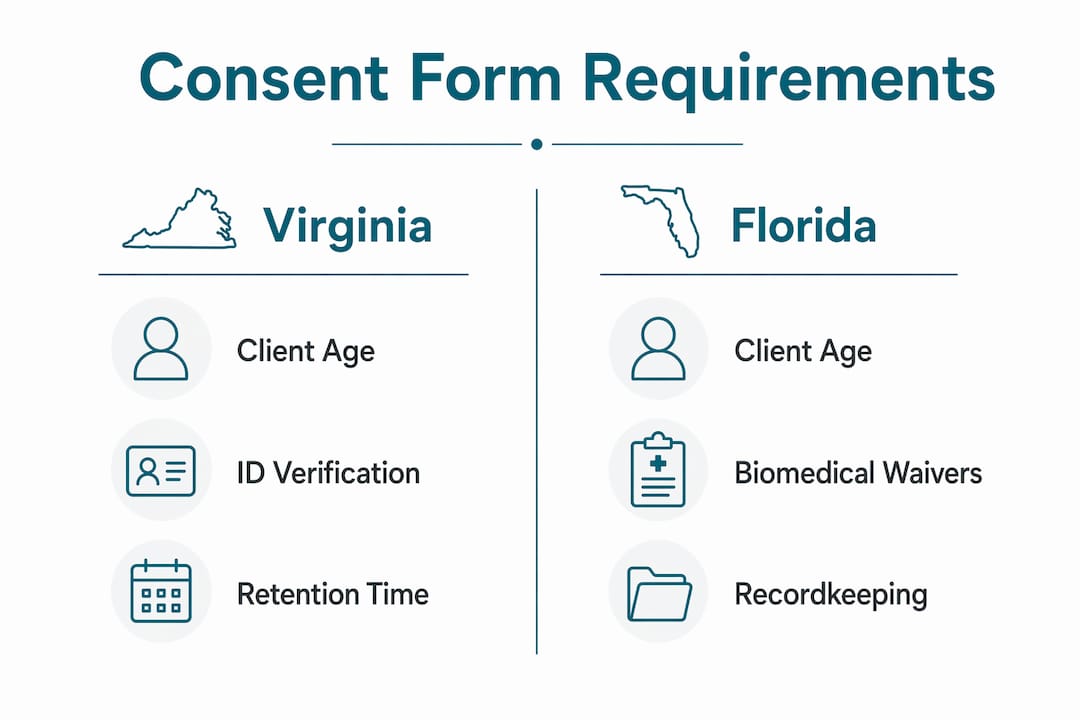
Recordkeeping is where many studios fall short. Signed consent forms must be retained for at least two years post-procedure in most states. Failure to maintain organized, accessible records risks fines or license suspension. Your microblading consultation form is not just a pre-appointment document. It is an ongoing compliance asset that must be stored securely and retrievable on demand.
For a detailed breakdown of minor client consent requirements across states, the rules around notarization and guardian presence deserve careful attention before you book any client under 18.
Why informed consent and patch tests matter for liability
Informed consent is the legal standard that requires a client to understand what they are agreeing to before signing. A signature alone does not constitute informed consent. The client must have received clear, plain-language information about the procedure, its risks, and the alternatives. Vague or jargon-heavy forms fail this standard, even if the client signed them.
Patch testing sits at the center of the liability conversation. Patch testing is recommended but not foolproof. Consent forms must give clients the documented choice to accept or waive the patch test, and that choice must be clearly recorded. When a client waives the patch test, the liability for any allergic reaction shifts to the client, provided the waiver language is unambiguous. This is one of the most important protective mechanisms in a microblading liability waiver.
Here is what strong informed consent language accomplishes:
- It confirms the client received and understood risk disclosures.
- It documents the patch test decision and its implications.
- It records the client’s acknowledgment of aftercare responsibilities.
- It establishes that the practitioner met their duty of care before proceeding.
“Clear patch test waiver language on consent forms shifts liability effectively, protecting practitioners from allergic reaction claims.”: Microblading by Joanna
Beyond legal protection, well-written consent forms build client trust. A client who reads a thorough, honest disclosure feels more confident in the studio’s professionalism. Rushed or incomplete forms send the opposite signal. The importance of consent forms in permanent makeup goes beyond compliance. It is a direct reflection of your studio’s standard of care.
How digital consent forms improve compliance and client experience
Digital consent forms have become the industry standard for microblading studios that prioritize audit readiness and client convenience. Digital forms ensure all required fields are completed before submission, eliminating the incomplete paperwork that creates problems during health inspections. A paper form with a blank medical history field is a liability. A digital form with mandatory field validation makes that gap impossible.
The practical benefits of switching to digital intake are significant:
- Mandatory field completion. No section can be skipped, so you never receive a form missing a signature or a critical health disclosure.
- E-signature capture. Electronic signatures are legally accepted in all 50 states under the ESIGN Act and UETA, making digital consent forms as binding as paper ones.
- Automated reminders. Digital forms can include automated reminders and integrated signature capture, which reduces no-shows and last-minute form scrambles.
- Secure cloud storage. Records are stored with timestamps and access logs, making retrieval straightforward during inspections or disputes.
- Pre-appointment completion. Clients complete the microblading consultation form before arriving, freeing up appointment time for the actual consultation rather than paperwork.
Pro Tip: Send your digital consent form 24 to 48 hours before the appointment. Clients who complete it in advance arrive informed and ready, which shortens your consultation time and reduces the chance of a same-day cancellation once they read the risk disclosures.
Integration with client management systems is the next level. When your digital intake connects to your booking and CRM tools, every client record is automatically linked to their signed consent, their patch test decision, and their aftercare acknowledgment. This is what audit-ready documentation looks like in practice. Digital intake for beauty salons has moved well past basic PDF forms. The studios using purpose-built platforms are operating with a compliance advantage their paper-based competitors simply do not have.
Key takeaways
A microblading consent form is a legal, clinical, and operational document that protects both the client and the practitioner, and its quality directly determines your studio’s compliance standing and liability exposure.
| Point | Details |
|---|---|
| Core purpose | The form captures medical history, risk acknowledgment, and informed consent before any procedure begins. |
| Required elements | Include ID verification, contraindications checklist, patch test decision, pigment lot numbers, and a signed liability waiver. |
| State compliance | Record retention runs at least two years post-procedure; minor consent rules vary significantly by state. |
| Patch test liability | Documented waiver of patch testing shifts allergic reaction liability from practitioner to client. |
| Digital advantage | Digital forms prevent incomplete submissions, support e-signatures, and create audit-ready records automatically. |
Why the form is the procedure, not the preamble
I have reviewed hundreds of microblading consent forms over the years, and the pattern is consistent. The studios with the fewest liability incidents are not necessarily the most technically skilled. They are the ones with the most thorough documentation. A practitioner who tracks pigment lot numbers, records the patch test decision with a dedicated signature, and stores timestamped digital records is operating at a fundamentally different risk level than one who hands clients a generic two-page PDF.
The mistake I see most often is treating the consent form as a formality to get through before the real work starts. That mindset is backwards. The consent form is where the procedure actually begins. It is where you identify contraindications that could turn a routine appointment into a medical incident. It is where you establish the legal record that protects you if a client later claims they were not informed of a risk.
One area that consistently surprises practitioners is how much the form affects client perception. Clients who receive a detailed, professionally designed digital consent form before their appointment arrive with more confidence and fewer objections. They have already processed the risks at home, in their own time. The consultation becomes a conversation rather than a disclosure session. That shift alone is worth the investment in a well-built form.
The other thing I would push back on is the idea that a template is enough. A generic microblading consent form template is a starting point, not a finished product. Your form needs to reflect your state’s specific requirements, your studio’s specific services, and the pigments and devices you actually use. Generic forms create generic protection, which is to say, not much.
— Artur
How Getconsentify helps microblading studios stay compliant
Getconsentify builds digital consent forms specifically for beauty and wellness professionals who need more than a PDF. For microblading studios, that means pre-built templates covering every required field, from contraindications and patch test waivers to pigment lot tracking and aftercare acknowledgments.
Every form includes e-signature capture, mandatory field validation, and secure cloud storage with timestamps. You can customize forms to match your state’s specific consent requirements, add your branding, and send forms automatically before appointments. Clients complete everything on their phone before they walk in. Your records are organized, searchable, and ready for any inspection. Explore Getconsentify’s beauty salon forms to see how studios are replacing paper intake with a system built for compliance from the ground up.
FAQ
What is a microblading consent form used for?
A microblading consent form documents a client’s medical history, risk acknowledgment, and informed agreement before the procedure. It protects both the client and the practitioner by creating a legal record of the consultation.
What should a microblading consent form include?
The form must include client ID verification, a medical history checklist covering contraindications, risk disclosures, patch test documentation, microblading aftercare instructions, pigment and device details, and a signed liability waiver.
How long must microblading consent forms be kept on file?
Signed consent forms and medical history records must be retained for at least two years post-procedure in most states. Failure to maintain accessible records can result in fines or license suspension.
Are digital microblading consent forms legally valid?
Yes. Electronic signatures are legally binding in all 50 states under the ESIGN Act and UETA. Digital consent forms also reduce the risk of incomplete documentation compared to paper forms.
Can a client with eczema or psoriasis sign a microblading consent form and proceed?
Clients with active skin conditions like psoriasis or eczema are generally advised to delay microblading, as these conditions affect pigment retention and skin healing. The consent form should document this contraindication and the client’s acknowledgment of the associated risks.