Digital Consent Forms with E-Signatures for Salons
Discover how digital form signature salon consent enhances client protection and boosts your salon's efficiency. Embrace e-signature solutions today!

Digital Consent Forms with E-Signatures for Salons

A digital form signature salon consent is a legally binding electronic document that captures a client’s informed agreement to a beauty or tattoo service before treatment begins. Unlike paper waivers, these forms use electronic signatures to create a verifiable, timestamped record that protects your business and your clients. Platforms like Getconsentify, DaySmart, and Tattoogenda have made this workflow standard practice for professional salons and studios. The shift from paper to digital is not just about convenience. It directly affects your legal standing, your client experience, and your ability to defend decisions if a dispute ever arises.
What legal requirements must digital consent forms meet for salons?
Electronic signatures carry real legal weight, but only when the form and the signing process meet specific standards. In Australia, e-signatures are legally recognized under the Electronic Transactions Act 1999 (Cth) when three conditions are satisfied: the signer’s identity is established, their intention to sign is clear, and the method used is appropriate for the context. This means using a dedicated platform that logs who signed, when, and how. A typed name in a generic email does not meet this standard.
For tattoo studios, the bar is higher. E-consent for tattoo work must prove client intent, maintain a complete audit trail, and comply with tattoo-specific local regulations. This includes collecting health screening data, allergy information, risk acknowledgment, and aftercare agreement as separate, clearly labeled sections. Bundling everything into one checkbox creates legal weakness, not protection.
Health data collected in consent forms also falls under privacy law. Under GDPR Article 9, health information is classified as special category data, requiring explicit consent and enhanced safeguards. Even if you operate outside the EU, this standard reflects global best practice for handling medical and contraindication data in beauty settings.
Key legal requirements for a valid salon electronic consent form include:
- Identity verification: The platform must capture who signed, using a name, email, or IP address tied to the client record.
- Intention to sign: The client must take a deliberate action, such as drawing a signature or checking a specific consent box, not just scrolling past text.
- Method reliability: Use a dedicated e-signature platform, not a generic form builder, to create a defensible audit trail.
- Minor client consent: Parental or guardian signature is required for clients under 18. Review minor consent requirements for your jurisdiction before designing these forms.
- Separate consent categories: Risk acknowledgment, photo release, patch test results, and aftercare agreement must each be distinct sections, not combined into one blanket agreement.
Pro Tip: Always include a plain-language summary at the top of each consent section. Clients who understand what they are agreeing to are far less likely to dispute it later.
How to design an efficient digital consent workflow

The most effective salon consent workflows remove friction for clients while creating airtight records for your business. Sending pre-appointment consent links via SMS or email means clients sign on their own device before they arrive. This eliminates reception bottlenecks and guarantees that signed forms are attached to client profiles before the appointment begins.
Follow these steps to build a workflow that actually holds up:
- Create service-specific forms. A hair color consultation needs different disclosures than a chemical peel or a tattoo. Build separate templates for each service category rather than using one generic waiver.
- Send the link automatically at booking. Connect your consent form platform to your booking system so the link fires the moment an appointment is confirmed. Clients complete it on their phone at home, not in a hurry at your front desk.
- Require completion before check-in. Set your system to flag incomplete forms. Staff should not begin a service without a signed consent attached to the client record.
- Attach signed forms to client profiles. Every signed form should link directly to the client’s profile with a timestamp and version number. This is the foundation of your audit trail.
- Handle on-site completion as a backup. Keep a tablet at reception for walk-ins or clients who missed the pre-appointment link. The process should be identical to the remote flow, not a paper fallback.
- Review and update forms annually. Regulations change. Service menus change. Your consent forms must reflect current practice.
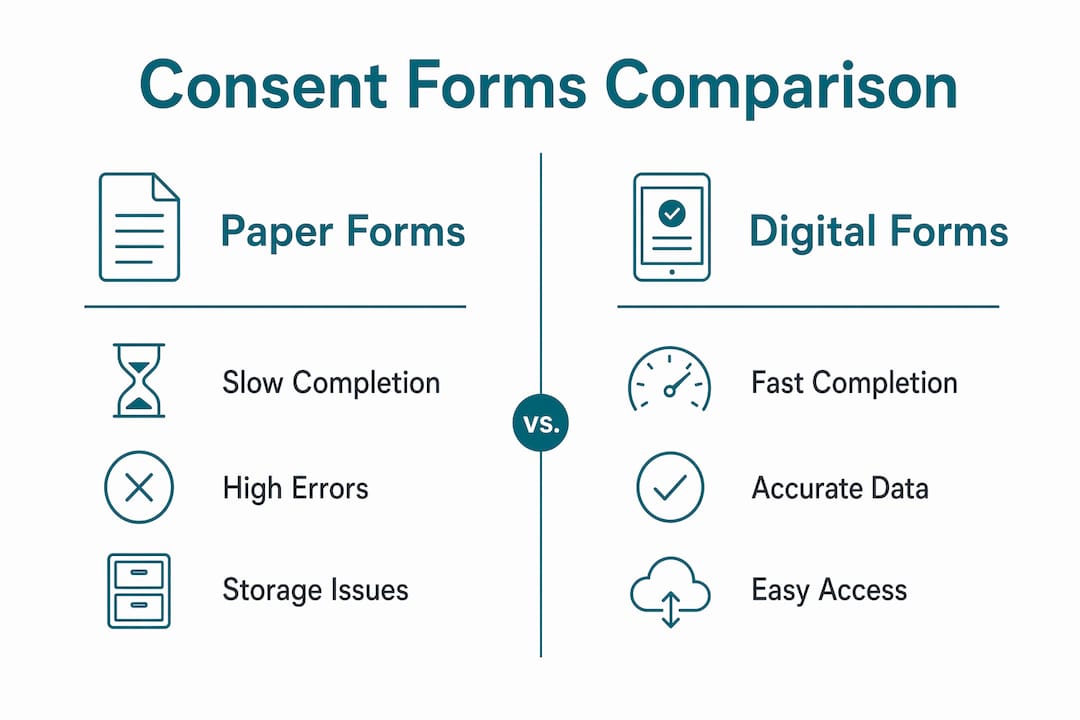
The table below shows how a digital workflow compares to a paper-based process across key operational metrics:
| Metric | Paper forms | Digital consent workflow |
|---|---|---|
| Completion before appointment | Rarely | Consistently, via pre-appointment link |
| Audit trail quality | Manual, prone to loss | Automated, timestamped, tamper-evident |
| Version control | Difficult to manage | Linked to exact form version signed |
| Storage and retrieval | Physical filing required | Instant search by client name or date |
| Minor consent handling | Easy to miss | Flagged automatically by platform |
Pro Tip: If a client arrives without completing their pre-appointment form, do not skip it. Use your on-site tablet to complete the full digital process. A verbal agreement is not a consent record.
Which platforms handle salon digital consent best?
Choosing the right tool determines whether your digital consent process is a genuine compliance asset or just a digital version of the same paper problem. The platforms most commonly used in salon and tattoo settings each have distinct strengths.
Getconsentify is purpose-built for beauty and wellness professionals. It supports branded forms, service-specific templates, secure e-signatures, and direct integration with client profiles. The platform is designed around the specific consent categories that salons and tattoo studios need, including patch test records, contraindication screening, and photo release. Consent form compliance is built into the workflow rather than added as an afterthought.
DaySmart Salon integrates digital waivers directly into its booking and client management system. Forms are sent automatically at booking, and signed documents attach to client profiles without manual steps. This makes it a strong choice for salons that already use DaySmart as their primary management platform.
Tattoogenda focuses specifically on tattoo studio consent, with e-consent workflows that address the unique legal requirements of tattooing, including ID verification, medical screening, and aftercare agreement as separate, required sections.
Key features to evaluate when comparing platforms:
- Audit trail quality: Does the system capture timestamps, user IDs, and the exact form version signed? Tamper-evident audit trails are non-negotiable for legal defensibility.
- Client experience: Can clients sign on any mobile device without creating an account or downloading an app?
- Version control: Does the platform link each signed form to the specific version the client agreed to?
- Storage compliance: Where is data stored, and does it meet the privacy standards relevant to your jurisdiction?
- Pricing structure: Per-form pricing suits low-volume studios. Subscription models favor high-volume salons.
Common mistakes that undermine digital consent in salons
The most damaging mistake salon owners make is treating digital consent as a one-time setup task. Document drift occurs when forms are updated but old versions remain in circulation, meaning some clients have signed outdated agreements that no longer reflect your current services or disclosures. Every update to a service protocol must trigger a form review.
The second most common failure is the bundled consent checkbox. Separating consent elements into distinct toggles for risk acknowledgment, photo release, and patch test results creates clearer client understanding and stronger legal protection. A single “I agree to everything” checkbox is legally weak and practically useless if a client later claims they did not understand what they consented to.
Other critical pitfalls to avoid:
- Skipping minor consent protocols. Tattooing or performing chemical services on a minor without a verified parental signature exposes your business to serious liability. Automate the age check in your intake flow.
- Inconsistent staff training. If one staff member accepts a verbal agreement while another insists on a signed form, your process has no integrity. Every team member must follow the same protocol, every time.
- Ignoring data security. Health and allergy data collected in consent forms is sensitive. Store it on platforms with encryption, access controls, and clear data retention policies.
- No offline backup plan. If your system goes down, staff need a clear protocol. A temporary paper form is acceptable only if it is digitized and attached to the client record the same day.
“A consent form that cannot be retrieved, verified, or matched to the exact version the client signed is not a consent record. It is a liability.”
Key takeaways
Digital consent forms with electronic signatures are legally enforceable only when identity, intention, method reliability, and proper form content are all present in a single, auditable workflow.
| Point | Details |
|---|---|
| Legal validity requires three elements | Identity, intention, and method appropriateness must all be satisfied under the Electronic Transactions Act 1999. |
| Separate consent categories matter | Risk, photo release, and patch test sections must be distinct to hold up legally and reduce client confusion. |
| Pre-appointment links drive completion | Sending forms via SMS or email before arrival eliminates reception delays and guarantees signed records. |
| Audit trails must be tamper-evident | Platforms must capture timestamps, user IDs, and form version numbers to create defensible records. |
| Document drift is a real compliance risk | Every service update must trigger a form review to prevent outdated versions from circulating. |
Why I think most salons are still one dispute away from a problem
I have reviewed a lot of salon consent setups, and the pattern is consistent. Owners invest in a booking system, add a digital form as an afterthought, and assume the problem is solved. It is not. The form is only as strong as the process around it.
The salons that genuinely protect themselves do three things differently. They treat consent as a client communication tool, not just a legal checkbox. They build version control into their workflow from day one, so every signed form is permanently linked to the exact service protocol in place at the time. And they train every staff member to treat an incomplete consent form the same way they would treat a missing booking confirmation: as a hard stop, not a suggestion.
The transition from paper to digital also reveals something most owners do not expect. Clients actually trust you more when the process is professional and transparent. A well-designed digital intake process signals that you take their safety seriously before they even sit in your chair. That perception has real value for retention and referrals, not just compliance.
The uncomfortable truth is that most disputes do not come from clients who were harmed. They come from clients who felt uninformed. A clear, well-structured consent form, sent before the appointment and explained at check-in, closes that gap before it opens.
— Artur
How Getconsentify makes digital consent simple for salons
Getconsentify is built specifically for beauty salons, tattoo studios, and wellness providers who need consent forms that are both legally sound and easy for clients to complete. The platform handles branded, service-specific templates with secure electronic signatures, automated pre-appointment delivery, and direct attachment to client profiles. Every signed form is stored with a full audit trail, including timestamps and form version data, so you are always audit-ready. If you are ready to replace paper waivers with a professional digital consent system, explore Getconsentify’s beauty salon solution and see how quickly your intake process can improve.
FAQ
What is a digital form signature salon consent?
A digital form signature salon consent is an electronic document that captures a client’s informed agreement to a beauty or tattoo service using a legally binding e-signature. It replaces paper waivers with a timestamped, auditable record stored in the client’s profile.
Are electronic signatures on salon consent forms legally valid?
Yes. Under the Electronic Transactions Act 1999 in Australia, e-signatures are legally valid when identity, intention, and method appropriateness are established. Using a dedicated platform like Getconsentify satisfies all three conditions.
What should a tattoo studio consent form include?
A tattoo consent form must include health screening, allergy information, risk acknowledgment, aftercare agreement, and ID verification as separate sections. Tattoo e-consent must also comply with local tattooing regulations and maintain a complete audit trail.
How do I send consent forms to clients before their appointment?
Connect your consent form platform to your booking system so a signing link is sent automatically via SMS or email at the time of booking. Clients sign on their own device before arriving, and the completed form attaches directly to their profile.
Do I need a different consent form for minor clients?
Yes. Services performed on clients under 18 require a verified parental or guardian signature. Review the specific minor consent requirements for your state or territory, and configure your intake flow to flag underage clients automatically.