Types of Body Modification Consent Forms: A Pro Guide
Discover the types of body modification consent forms to protect your practice. Learn key legal distinctions and choose the right form today!

Types of Body Modification Consent Forms: A Pro Guide

Body modification consent forms are legally binding documents that clients sign to acknowledge procedure risks and grant explicit permission for services. These forms protect both the artist and the client, and four main categories exist across the industry: adult tattoo, adult piercing, minor tattoo, and minor piercing forms. Each type carries distinct legal requirements, risk disclosures, and documentation standards. Professionals who treat all consent forms as interchangeable expose themselves to serious liability. This guide breaks down every major form type, explains what separates them legally, and shows you how to choose or build the right document for your practice.
1. Types of body modification consent forms and why distinctions matter
The types of body modification consent forms used in professional studios fall into six core categories, each serving a different legal and procedural purpose. Treating them as one generic document is the most common compliance mistake in the industry.
- Adult tattoo consent form. This is the baseline document for tattooing clients aged 18 and over. It covers procedure description, placement confirmation, health screening questions, contraindications, aftercare acknowledgment, and a signature confirming informed consent.
- Adult piercing consent form. A piercing consent form, sometimes called a body piercing consent agreement, addresses anatomy-specific risks such as infection, rejection, and nerve sensitivity. It differs from a tattoo form because the risk profile and aftercare protocols are procedure-specific.
- Minor tattoo consent form. In most U.S. jurisdictions, tattooing minors requires documented parental or guardian consent. Some states prohibit it entirely. Illinois law, for example, permits tattooing a minor only by a licensed physician, making a standard studio consent form legally insufficient on its own.
- Minor piercing consent form. Oral piercings on minors carry specific informed consent requirements. Under Illinois piercing law, a consent form for mouth piercings must explicitly warn about infection risk and nerve damage. Generic language does not satisfy this standard.
- Notary-required minor consent form. Several studios and jurisdictions require a notarized parental consent packet for minors. This format adds legal weight and reduces the risk of forged signatures.
- Specialized procedure forms. Branding, scarification, subdermal implants, and tongue splitting each carry risk profiles that standard tattoo or piercing forms do not cover. These procedures require their own dedicated consent documents.
Pro Tip: Keep each form type in a separate template file, labeled by procedure and client age group. Mixing content from different form types into one document creates ambiguity that weakens legal defensibility.
2. Adult tattoo consent forms: what they must include
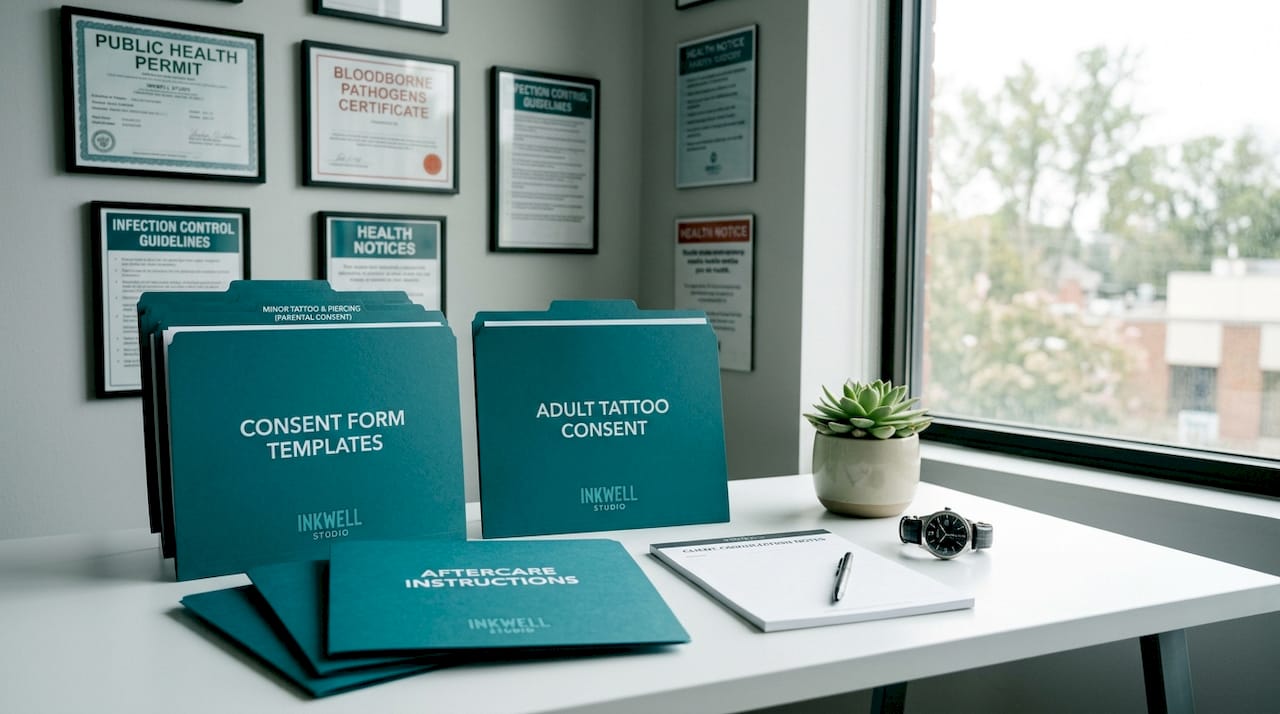
An adult tattoo consent form is the most frequently used document in any studio, and its quality directly reflects your professional standard. A well-built form does more than collect a signature. It creates a documented record that the client understood the procedure, disclosed relevant health information, and agreed to the specific work being performed.
Effective consent forms require truthful health disclosures and signatures confirming understanding before any service begins. This means your adult tattoo form should include a health screening section covering conditions such as blood-thinning medication use, diabetes, keloid scarring history, and pregnancy. It should also include a tattoo placement consent section, where the client confirms the exact location and design they approved. Tattoo placement consent form examples typically ask clients to initial a body diagram alongside a written description of placement.
Photo consent is a separate but related issue. Tattoo photo consent form examples show that studios often include a standalone photo release clause or a separate photo consent form, giving clients the option to opt in or out of having their work shared on social media. This distinction matters because bundling photo consent into the main form can make the entire document contestable if a client later disputes the photo use.
3. Adult piercing consent forms: procedure-specific risk language
A piercing consent form is a written agreement in which a client acknowledges the specific risks of their chosen piercing and consents to the procedure. The key word is “specific.” Generic risk language across different body modification procedures weakens client understanding and legal defensibility. This means a navel piercing form and a septum piercing form should not share identical risk language.
Your adult piercing consent form should address the anatomy involved, the healing timeline for that specific piercing, known contraindications such as nickel sensitivity or autoimmune conditions, and the client’s acknowledgment of aftercare responsibilities. Studios that use a single generic piercing form for all placements are leaving themselves exposed. A client who develops a complication from a daith piercing and can show the form contained no daith-specific risk information has a much stronger complaint.
Pro Tip: Build a modular piercing consent form with a shared header section and swappable risk disclosure blocks by piercing type. This keeps your workflow fast while maintaining procedure-specific accuracy.
4. How minor consent forms differ legally and operationally
Minor consent forms represent the most legally complex category in body modification consent agreements. The differences from adult forms are not cosmetic. They are structural, jurisdictional, and operationally demanding.
Here is how the process typically differs when a minor is involved:
- Verify age with government-issued ID. Accepting a verbal claim of age is not sufficient. Require a birth certificate or state ID and document the verification.
- Require in-person parental or guardian presence. Many jurisdictions require the parent or guardian to be physically present at the time of service, not just to sign a form in advance.
- Use a dedicated minor consent form. Minor consent forms often take a separate “minor consent and release” format requiring additional formalities such as notarization. A standard adult form with a parent’s signature added at the bottom does not meet this standard.
- Collect supporting documentation. Studios working with minors should collect copies of the parent’s ID alongside the minor’s ID or birth certificate. This creates a complete authorization record.
- Apply notarization where required. Notary packets and separate minor documentation enhance legal reliability. Notarization confirms the parent’s identity and the authenticity of their signature.
- Store records securely and separately. Minor consent records carry heightened privacy obligations. Keep them in a separate, access-controlled file, whether physical or digital.
Minor consent workflows differ substantially by jurisdiction, which increases complexity and the need for tailored forms. What satisfies legal requirements in Texas may not meet the standard in California or New York. Consulting a local attorney to review your minor consent process is not excessive caution. It is standard professional practice.
5. Notary-required consent forms: when and why you need them
Notarized consent forms are required in specific jurisdictions and for specific procedures involving minors. A notary public verifies the identity of the signing parent or guardian and witnesses the signature, adding a layer of authentication that a standard studio form cannot provide.
The practical implication is that your studio needs a clear intake workflow for notarized consent. Some studios partner with a local notary service or use a remote online notarization platform to reduce friction for clients. The form itself must be formatted to include a notary acknowledgment block with space for the notary’s seal and signature. Standard consent form templates downloaded from general legal sites rarely include this block correctly formatted for body modification contexts.
Not every minor procedure requires notarization, but the risk of not having it when it is required far outweighs the administrative effort of implementing it universally for minor clients.
6. Specialized procedure consent forms for advanced body modification
Branding, scarification, subdermal implants, and tongue splitting require consent forms that go well beyond standard tattoo or piercing language. These procedures carry risks including permanent disfigurement, infection requiring surgical intervention, and psychological impact, none of which are adequately covered by a generic body modification consent agreement.
A specialized procedure form should include a detailed description of the procedure written in plain language, a risk disclosure section specific to that procedure’s known complications, a statement confirming the client has had the opportunity to ask questions, and a declaration that the client is not under the influence of substances. For procedures with permanent or near-permanent outcomes, some studios include a mandatory waiting period clause, requiring the client to return on a separate day to sign and proceed. This reduces impulsive decisions and strengthens the informed consent record.
7. Tailoring consent forms to specific procedures: best practices
Procedure-specific risk disclosures and pre-service screening are the standard that template libraries now emphasize. Applying this standard to your own forms requires a structured approach.
- Map risks to procedures. List every service you offer and identify the distinct risks for each. A lip tattoo carries different infection and fading risks than an arm sleeve. Your form should reflect that.
- Build health screening questions by procedure type. A client getting a chest tattoo near a pacemaker needs different screening questions than a client getting an earlobe piercing. Procedure-matched screening catches contraindications that generic questions miss.
- Use addenda for complex cases. If a client has a disclosed health condition relevant to the procedure, attach a procedure-specific addendum to the standard form. This documents that the risk was addressed directly.
- Separate photo consent from service consent. Bundling photo release into the main consent form creates legal ambiguity. Use a standalone photo consent form that clients can sign independently. This is now considered best practice for tattoo photo consent form examples across the industry.
- Review forms annually. Regulations change. Aftercare science evolves. A form that was legally sufficient in 2023 may not meet current standards. Schedule an annual review with a legal advisor familiar with your state’s body modification regulations.
8. Comparing consent form templates vs. digital software solutions
Choosing between static PDF templates and digital consent form software is a practical decision that affects your compliance, workflow, and client experience.
| Criteria | PDF / Paper Templates | Digital Consent Software |
|---|---|---|
| Legal robustness | Depends on template quality; no audit trail | Electronic signatures with timestamps and IP logging |
| Customizability | Manual edits required; version control is difficult | Modular fields, conditional logic, easy updates |
| Workflow integration | Requires printing, scanning, or manual filing | Integrates with booking and CRM systems |
| Record keeping | Physical storage or manual scanning | Automated cloud storage with search and retrieval |
| Client experience | Paper forms feel dated; legibility issues | Mobile-friendly; clients complete forms before arrival |
| Cost | Low upfront; high labor cost over time | Subscription-based; reduces administrative hours |
Digital consent solutions improve workflow efficiency and record-keeping for body modification consent forms. For studios processing high client volumes, the time saved on filing, retrieval, and re-signing alone justifies the switch. The best tattoo consent form software options include platforms built specifically for the beauty and wellness industry, offering branded forms, automated reminders, and HIPAA-aligned storage. Getconsentify is one platform designed for exactly this use case, offering digital intake forms tailored to clinics and body modification studios.
For professionals evaluating options, the non-negotiable criteria are electronic signature capture, timestamped records, and the ability to customize forms by procedure type. A platform that forces you into a single generic template defeats the purpose of procedure-specific consent.
Key takeaways
The most legally defensible body modification consent forms are procedure-specific, client-age-appropriate, and stored with a verifiable electronic or notarized signature record.
| Point | Details |
|---|---|
| Six core form types exist | Adult tattoo, adult piercing, minor tattoo, minor piercing, notarized minor, and specialized procedure forms each serve distinct legal purposes. |
| Minor forms require extra steps | Parental presence, ID verification, notarization, and jurisdiction-specific compliance are required beyond a standard signature. |
| Generic risk language is a liability | Procedure-specific risk disclosures and health screening questions are the legal and ethical standard, not optional enhancements. |
| Digital software outperforms paper | Electronic signatures, audit trails, and cloud storage reduce compliance risk and administrative labor significantly. |
| Photo consent needs its own form | Bundling photo release into service consent creates legal ambiguity; a standalone photo consent form is best practice. |
Why I think most studios are one audit away from a problem
I have reviewed consent form setups across dozens of studios, and the pattern is consistent. Most professionals are using a single form they downloaded years ago, modified slightly, and never revisited. It covers the basics, it has a signature line, and it feels like enough. It usually is not.
The most common gap I see is not in the legal language. It is in the specificity. A client who develops a keloid after a cartilage piercing and can show the form never mentioned keloid risk for that placement has a legitimate complaint. A parent who signed a minor consent form that was never notarized, in a jurisdiction that requires notarization, creates real exposure for the studio.
The second gap is photo consent. Studios routinely post client work on Instagram and TikTok without a standalone photo release. Bundling it into the main consent form is not sufficient protection when a client disputes it later.
My honest advice: treat your consent forms as living documents, not administrative checkboxes. Review them annually, match them to your specific service menu, and separate your photo consent from your service consent. If you are doing any work on minors, get a local attorney to review your minor consent workflow once. That single investment will cost less than one legal dispute.
— Artur
How Getconsentify simplifies your consent form workflow
Managing six or more distinct consent form types across adult and minor clients, multiple procedures, and evolving regulations is a real operational challenge. Getconsentify is built to handle exactly that. The platform lets you create branded, procedure-specific digital consent forms that clients complete on any device before they arrive. Electronic signatures are timestamped and stored automatically, giving you a clean audit trail without manual filing. Conditional logic means clients only see the questions relevant to their procedure, keeping the experience fast and professional. For studios that want to move beyond paper without rebuilding their entire intake process, Getconsentify is the direct solution.
FAQ
What are the main types of body modification consent forms?
The four primary types are adult tattoo, adult piercing, minor tattoo, and minor piercing consent forms. Specialized procedures such as branding or scarification require additional dedicated forms.
What is a piercing consent form and what must it include?
A piercing consent form is a written agreement in which a client acknowledges procedure-specific risks and consents to the piercing. It must include anatomy-specific risk disclosures, health screening questions, aftercare acknowledgment, and a signed confirmation of informed consent.
When is a notarized consent form required for minors?
Notarization requirements vary by jurisdiction, but notary packets are used when studios or state law require verified parental identity and signature authentication for body modification on minors.
Why do tattoo studios need separate consent forms by procedure?
Reusing generic risk language across different procedures weakens both client understanding and legal defensibility. Procedure-specific forms address the exact risks, contraindications, and aftercare relevant to each service.
What is the best tattoo consent form software for studios?
The best platforms offer electronic signature capture, timestamped records, procedure-specific customization, and cloud storage. Getconsentify is designed specifically for clinics and beauty professionals, combining branded digital forms with automated record-keeping in one platform.