How Tattoo Digital Forms Work: A Client's Guide
Discover how tattoo digital forms work to enhance your experience. Enjoy a faster, safer process with instant access to your information.

How Tattoo Digital Forms Work: A Client’s Guide

A digital tattoo form is an electronic consent and intake document that clients sign via phone, tablet, or computer before their appointment, replacing paper forms with encrypted, time-stamped records that studios access instantly. Understanding how tattoo digital forms work matters whether you are booking your first piece or your fifteenth. These forms are not just a tech upgrade. They are the foundation of a safer, faster, and more legally sound tattoo experience for everyone in the room.
How digital tattoo forms work in the consultation workflow
Digital tattoo forms slot into the booking process at a specific, deliberate moment. SMS-based form delivery doubles pre-appointment completion rates compared to in-studio paper signing. That means the moment you confirm your booking, a link arrives in your inbox or via text, and you complete your forms from your couch rather than a waiting room chair.
Here is the typical sequence from booking to session:
- Booking confirmation sent. You receive an automated message with a link to your digital intake form immediately after your appointment is confirmed.
- Client completes forms remotely. You fill out medical screening questions, consent sections, risk acknowledgments, and design preference notes on your own device at your own pace.
- Studio receives completed records. Your signed form attaches automatically to your client profile in the studio’s management system, no manual filing required.
- Walk-in backup available. For clients who arrive without completing forms, studios provide a tablet or QR code at the front desk to complete the process on the spot.
- Staff verify at check-in. A quick review confirms your signatures and ID match before your artist picks up a needle.
Many forms also include a design preferences section, which connects the intake process directly to the digital tattoo design process. You can describe placement, size, style references, and color preferences before you walk in, giving your artist a head start on preparation.
Pro Tip: Fill out your digital form the same day you receive it. Completion rates drop significantly when clients wait until the day before their appointment.

What makes a digital tattoo form legally and technically effective?
Not every digital form is built the same. The best platforms combine client-friendly design with features that hold up legally and protect your personal data.
Core fields every form must include
- Full legal name, date of birth, and contact information
- Government ID verification or photo upload
- Medical screening questions covering contraindications like blood thinners, skin conditions, and immune disorders
- Risk acknowledgment sections requiring initials on each high-risk clause, not just a single signature at the end
- Aftercare instructions with a separate acknowledgment
- Photo release clause, clearly separated so clients understand what they are agreeing to
Security and legal defensibility
Electronic signatures under the ESIGN Act carry the same legal weight as handwritten signatures and include timestamp and device metadata for a complete audit trail. This matters when a dispute arises months after a session. Digital forms protected by AES-256 encryption at rest and TLS 1.2 or higher in transit give studios a chain of custody that paper simply cannot replicate. Audit logs capture every access, modification, and export event, proving exactly which version of a form was signed, when, and by whom.
Pro Tip: When you receive a digital form, read the risk acknowledgment sections carefully before initialing. Those initials signal that you understood specific risks, not just that you clicked through.
Mobile-first design is equally critical. Forms with large tap targets, short labeled sections, and progress indicators see significantly lower abandonment rates than those designed for desktop and scaled down. If a form feels frustrating on your phone, that is a design failure on the studio’s part, not yours.
| Feature | Why it matters |
|---|---|
| E-signature with timestamp | Proves consent was given at a specific date and time |
| Device and IP metadata | Confirms the client signed, not a third party |
| AES-256 encryption | Protects sensitive health data from unauthorized access |
| Role-based access controls | Limits who on staff can view or edit client records |
| Integration with booking system | Keeps consent records linked to the correct session |
Digital forms vs. paper forms: what actually changes?
The practical differences between digital and paper tattoo consent forms go beyond convenience.
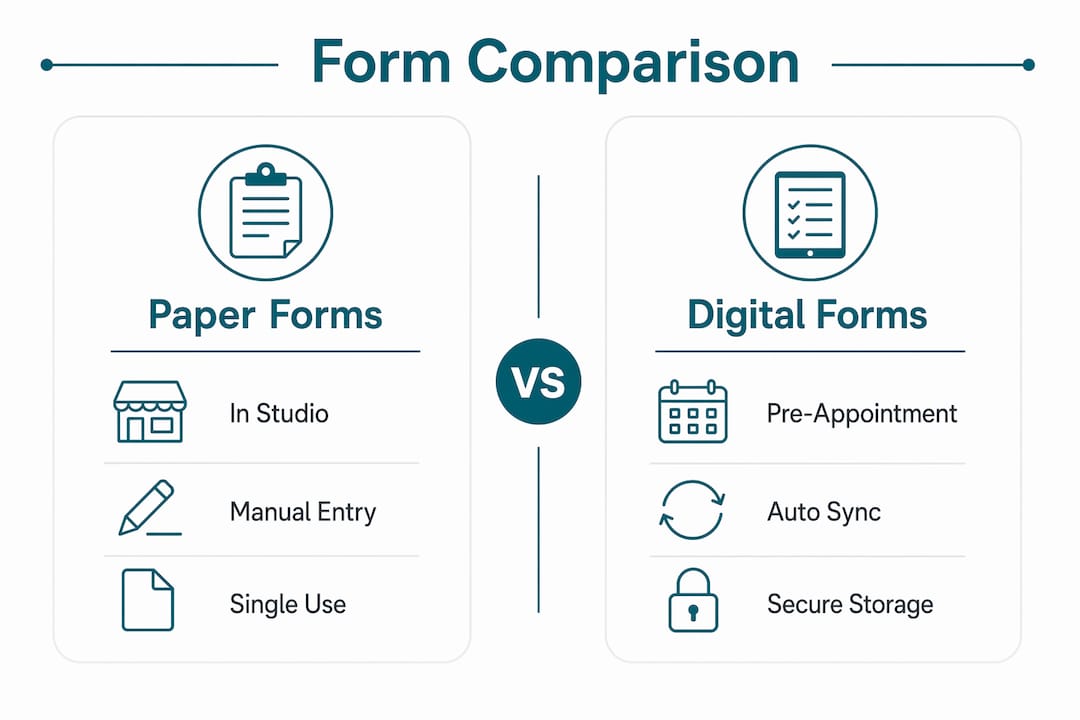
| Factor | Paper forms | Digital forms |
|---|---|---|
| Completion timing | In studio, day of appointment | Before arrival, on client’s device |
| Error rate | High: missed signatures, illegible writing | Low: required fields prevent incomplete submissions |
| Storage and retrieval | Physical filing, manual search | Searchable digital archive with instant retrieval |
| Legal defensibility | Limited: no audit trail | Strong: timestamps, metadata, and immutable logs |
| Client experience | Rushed, pen-and-paper pressure | Relaxed, completed at home |
Digital consents speed check-in, reduce admin errors, and provide clearer legal defense in disputes. That last point is significant. A paper form with a smudged signature and no date stamp is a weak defense in a liability claim. A digital record with a verified e-signature, timestamp, and audit log is a much stronger one.
The main barriers to digital adoption are real but manageable. Some clients lack reliable smartphone access, which is why QR code or tablet backup at the front desk is non-negotiable. Staff also need brief training to verify digital records at check-in rather than shuffling paper folders. Mixing paper and digital archives creates the worst of both worlds: inconsistent records, harder retrieval, and weaker audit trails. Studios that commit fully to digital storage see the clearest operational gains.
How digital forms improve your experience as a client and artist
For clients, the biggest shift is time and mental space. Completing forms before your session removes the rushed, clipboard-in-the-waiting-room feeling that makes first-time clients especially anxious. You read each section at your own pace, ask questions before you arrive, and show up ready to focus on the creative work.
For artists, pre-completed digital forms change session preparation entirely. When your artist receives your full intake record the night before, including your design preferences, placement notes, and any contraindications, they can prepare stencils, source reference images, and flag any health considerations before you sit down. That is a direct improvement to the digital tattoo design process.
The operational benefits compound across multi-artist and multi-location studios:
- Automatic reminders reduce unsigned form incidents without any manual follow-up from staff
- Integrated platforms attach signed forms directly to client profiles, eliminating the risk of losing the connection between a waiver and a session record
- Compliance recordkeeping becomes consistent across all artists and locations without additional administrative overhead
- Clients who cancel or reschedule retain their completed forms, so they do not repeat the process unnecessarily
Pro Tip: Before your appointment, review your completed digital form one more time. If your health status has changed since you filled it out, notify the studio. Updated disclosures protect both you and your artist.
Key takeaways
Digital tattoo forms work by replacing paper consent documents with encrypted, mobile-friendly records that clients complete before their appointment, giving studios a legally defensible, instantly retrievable audit trail.
| Point | Details |
|---|---|
| Send forms immediately after booking | SMS or email delivery right after confirmation produces the highest pre-appointment completion rates. |
| Require initials on risk sections | Section-by-section initials prove clients read and agreed to specific risks, not just signed a general waiver. |
| Use AES-256 encryption and audit logs | Encryption and immutable logs prove exactly which form was signed, when, and by whom. |
| Go fully digital, not hybrid | Mixing paper and digital archives weakens retrieval, consistency, and legal defensibility. |
| Pre-session forms improve artist prep | Complete intake data before the session allows artists to prepare designs and flag contraindications in advance. |
Why I think studios underestimate the client side of digital forms
Most conversations about digital tattoo consent forms focus on the studio: liability protection, admin efficiency, compliance. Those benefits are real. But the client experience angle is consistently undervalued, and that is where the actual adoption success or failure happens.
I have seen studios implement technically solid digital form systems and still get pushback from clients who find the forms confusing, too long, or poorly formatted on mobile. The form is often the first direct interaction a client has with a studio after booking. If it feels like a legal obstacle rather than a professional intake process, it sets the wrong tone before anyone picks up a machine.
The studios that get this right treat the digital form as part of the client relationship, not just a compliance checkbox. Plain language, clear section labels, and a logical flow from personal details through medical screening to design preferences make the process feel intentional. Clients who understand what they are signing and why are more confident, more communicative, and less likely to cancel.
Choosing an integrated platform matters more than most studios realize. A form that lives separately from your booking system creates a gap where records get lost, staff chase signatures, and the connection between a waiver and a session breaks down. Platforms that attach signed forms automatically to client profiles close that gap entirely. For anyone booking a tattoo, a studio using a well-designed digital intake system is a signal of professionalism worth noticing.
— Artur
Take your studio paperless with Getconsentify
Getconsentify offers digital consent forms built specifically for tattoo studios, beauty clinics, and wellness professionals. Every form includes mobile-first design, e-signature capture with timestamp and device metadata, AES-256 encrypted storage, and automatic attachment to client records. The platform integrates with your existing booking workflow so signed forms reach your artists before the session starts, not after the client sits down. Studios using Getconsentify report faster check-in, fewer unsigned form incidents, and cleaner compliance records across multiple artists and locations. If you are ready to replace paper chaos with a secure, professional intake process, Getconsentify is the place to start.
FAQ
How do tattoo digital forms work for walk-in clients?
Walk-in clients who have not pre-completed a form can use a studio-provided tablet or scan a QR code at the front desk to complete the digital intake process on arrival. Staff verify completion and ID before the session begins.
Are digital tattoo consent forms legally valid?
Electronic signatures compliant with the ESIGN Act carry the same legal weight as handwritten signatures and include timestamp and device metadata. Digital forms with immutable audit logs are generally more defensible in disputes than paper forms.
What information does a digital tattoo form collect?
A standard digital tattoo form collects your full legal name, date of birth, contact information, medical history relevant to tattoo healing, risk acknowledgments, aftercare consent, and an optional photo release. Many forms also include a design preferences section.
How is my personal data protected on a digital tattoo form?
Reputable platforms use AES-256 encryption at rest and TLS 1.2 or higher in transit, with role-based access controls limiting which staff members can view or edit your records. Audit logs track every access and modification event.
Can I complete a digital tattoo form before my appointment?
Yes, and studios actively encourage it. Sending the form link immediately after booking confirmation produces the highest completion rates and allows your artist to review your intake information before your session.