Why Update Client Intake Forms Regularly: A Business Guide
Learn why update client intake forms regularly to enhance client safety, reduce liability, and protect your business reputation. Discover essential steps!

Why Update Client Intake Forms Regularly: A Business Guide

Client intake forms are the legal and clinical record that connects your service to your client’s health, consent, and personal circumstances. Outdated forms expose beauty salons, tattoo studios, and esthetic practices to liability, adverse reactions, and compliance failures. Knowing why update client intake forms regularly matters is not a paperwork concern. It is a direct factor in client safety, business reputation, and legal standing. This guide breaks down the real risks, the measurable benefits, and the practical steps to keep your forms current.
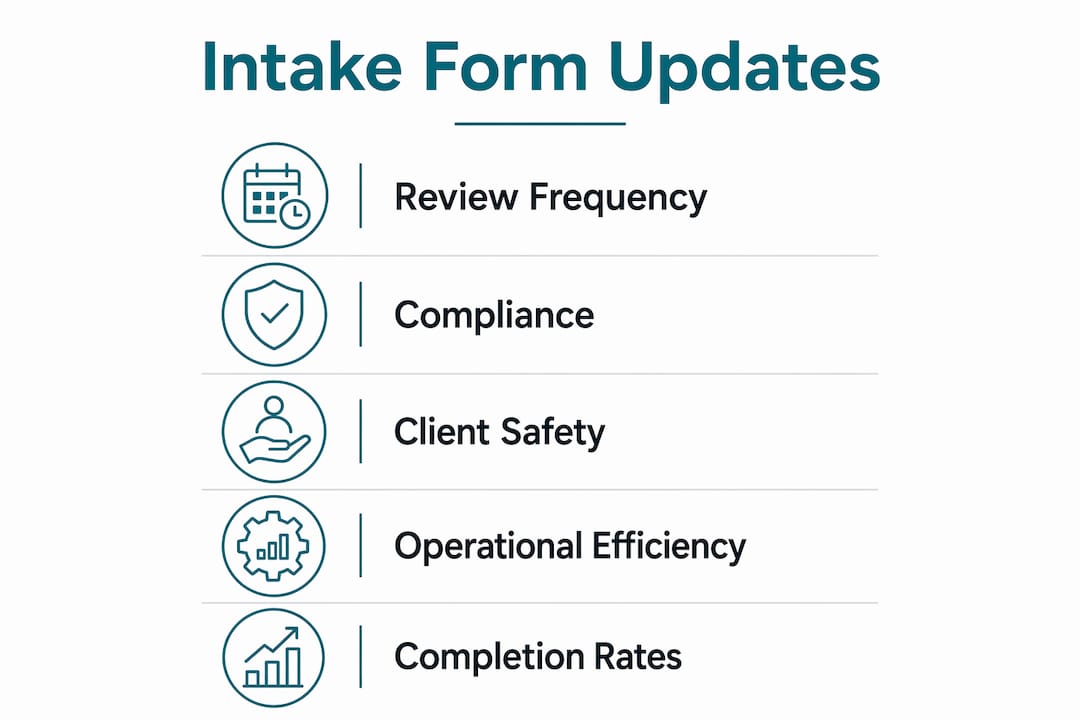
What risks arise from outdated client intake forms?
Outdated intake forms create three categories of risk: legal, clinical, and operational. Each one can damage your business in a different way, and all three are preventable.

Legal liability is the most immediate concern. Consent disclosures change as regulations evolve. A waiver that was compliant two years ago may be missing language required today. If a client experiences an adverse reaction and your form lacks a current, signed disclosure, your legal exposure increases significantly.
Clinical risk follows directly from stale health information. A client who started a blood thinner, developed a new allergy, or began isotretinoin treatment since their last visit is a different client than the one your old form describes. Client health and medications change often; using outdated records increases the chance of a treatment error, a contraindication missed, or a patch test skipped when it should not be.
Operational risk is subtler but equally damaging. When your team uses disconnected local PDF copies of forms, version drift causes staff to use outdated versions with missing consent disclosures. One artist uses last year’s version. The front desk uses a version from three years ago. The inconsistency creates data conflicts, confuses your records, and undermines internal trust.
“Without centralized form control, version drift leads to compliance gaps and increased risk.” Regulatory experts consistently flag this as a hidden vulnerability for service businesses that rely on paper or unmanaged digital files.
The pattern is clear: informal intake form management creates hidden compliance risks that only surface when something goes wrong. By then, the damage is done.
How do regularly updated intake forms improve client safety and experience?
Fresh intake data directly improves the quality of every service you deliver. When a client’s information is current, you can make better decisions before you pick up a needle or apply a chemical treatment.
Updated forms capture changes that clients often forget to mention verbally. A new medication, a recent surgery, a shift in skin sensitivity, or a lifestyle change like pregnancy can all affect how you approach a service. Regular updates enable safer, tailored services and reduce adverse events by giving you the full picture before the appointment begins.
The client experience benefit is equally real. Clients notice when you ask relevant, current questions. It signals professionalism and care. A client who sees that your intake process reflects their actual situation trusts your judgment more. That trust translates to retention, referrals, and reviews. You can read more about this dynamic in Getconsentify’s breakdown of how intake forms personalize beauty services.
- Review health and medication status at every visit, not just the first one.
- Ask about recent procedures such as laser treatments, fillers, or surgeries that affect your service.
- Confirm allergy and sensitivity updates before chemical services, waxing, or tattooing.
- Capture lifestyle changes including pregnancy, new dietary supplements, or sun exposure habits.
- Update contact and emergency information at least annually.
Completion rates also improve when forms stay relevant. Automated reminders sent 24 and 2 hours before appointments boost form completion from around 60% to 85% or higher. Higher completion means fewer gaps in your records and fewer delays at the start of an appointment.
Pro Tip: Link your intake form directly to your current service menu and policy page. Clients who see their consent tied to a specific service are more likely to read it carefully and complete it accurately.
Paper vs. digital intake forms: which handles updates better?
The difference between paper and digital intake forms is not just convenience. It is a governance gap that affects compliance, accuracy, and the time your team spends on administration.
| Factor | Paper forms | Digital forms |
|---|---|---|
| Update speed | Manual reprint and redistribution required | Instant update across all access points |
| Version control | High risk of staff using outdated copies | Centralized control prevents version drift |
| Completion rates | Dependent on in-person reminders | Automated reminders push rates to 85%+ |
| Onboarding time | Full manual data entry required | 50–70% reduction in onboarding time |
| Compliance audit trail | Paper files, easy to lose or misfiled | Digital records with timestamps and signatures |
| Client preference | Declining; clients expect digital options | Clients prefer completing forms on their phones |
The onboarding time reduction is significant. A clinic seeing 15 new clients weekly can save 5–8 admin hours per week by switching to digital intake. That time goes back to actual client care.
Excellent form governance ensures all staff use the latest, compliant forms. With paper, governance depends entirely on whoever manages the filing cabinet. With digital systems, governance is built into the platform. One update propagates everywhere, immediately.
Pro Tip: When you switch to digital intake, archive your paper versions with a clear date stamp. You may need them for historical records, but your team should never pull them for active use.
The Getconsentify 2026 guide to digital intake forms for beauty salons covers the full transition process if you are moving from paper to digital this year.
Client intake form best practices: how often should you revise?
The importance of client intake updates is clear. The harder question is when and how to act on it. A structured review cycle removes the guesswork.
Scheduled review triggers:
- Before peak seasons. Review your forms before summer, holiday, and wedding seasons when client volume spikes. Periodic reviews before key seasonal cycles maintain intake consistency and catch irrelevant questions before they slow down busy periods.
- After any regulation change. If your state board, health department, or professional association updates its consent or disclosure requirements, your forms must reflect that change immediately.
- After adding a new service. Every new treatment, product line, or technique requires its own contraindication and consent language.
- After a client complaint or incident. Any adverse event is a signal that your intake process missed something. Review the form that was in use at the time.
- At minimum, once per year. An annual review catches drift even when no specific trigger has occurred.
How to run an effective review:
Monitoring form abandonment patterns reveals confusing or unnecessary questions that should be revised or removed. If clients consistently skip a question or drop off at a certain point, that section needs attention. Iterative updates based on this kind of data improve both completion rates and the quality of information you collect.
Linking intake forms to policy pages and automating email confirmations improve client clarity. Clear workflows reduce follow-ups and manual errors after the appointment. Intake forms should function as living documents in a version-controlled repository, not static files that get forgotten between busy seasons.
For tattoo artists specifically, Getconsentify’s guide on tattoo client intake form essentials covers the specific fields and consent language that need regular review in that context.
Key Takeaways
Regularly updating client intake forms is the single most effective way to protect your business from liability, prevent adverse reactions, and build lasting client trust.
| Point | Details |
|---|---|
| Outdated forms create legal risk | Missing or expired consent disclosures increase liability when adverse events occur. |
| Health data changes between visits | Medications, allergies, and procedures change; forms must capture these updates before each service. |
| Digital forms prevent version drift | Centralized digital systems ensure all staff use the current, compliant version at all times. |
| Seasonal and event-based reviews work best | Review forms before peak seasons, after new service launches, and following any regulation change. |
| Completion rates improve with reminders | Automated reminders lift form completion from around 60% to 85% or higher, reducing appointment delays. |
Why I think most beauty businesses underestimate this problem
Most business owners I talk to treat intake form updates as a once-a-year task at best, usually right before a health inspection or after a client complaint. That is the wrong frame entirely.
The real issue is that your intake form is a snapshot of your client at a specific moment in time. The moment that snapshot goes stale, every decision you make based on it carries more risk than you realize. I have seen estheticians perform chemical peels on clients who started retinoids since their last visit, simply because no one updated the form. The client did not think to mention it. The form did not ask again.
The businesses that handle this well treat their intake forms the way a good accountant treats financial records: structured, dated, version-controlled, and reviewed on a fixed schedule. They do not wait for a problem to prompt a review. They build the review into their operating calendar.
Digital tools make this far easier than it used to be. The barrier is not technology. The barrier is the mindset that intake forms are administrative overhead rather than a core part of your service delivery. Shift that mindset, and the updates become automatic.
— Artur
How Getconsentify keeps your intake forms current and compliant
Keeping forms updated manually is the part of the process that breaks down most often for busy studios and salons.
Getconsentify builds digital intake forms specifically for beauty and tattoo professionals. Every form is centrally managed, so one update reaches every client touchpoint instantly. Automated reminders push completion rates well above the industry average. Branded, mobile-friendly forms give clients a professional experience before they walk through your door. Visit the Getconsentify beauty and wellness page to see the intake form templates built for your industry, including consent language, contraindication fields, and version control tools designed for salons, studios, and esthetic practices.
FAQ
Why update client intake forms regularly?
Client health, medications, and personal circumstances change between visits. Regular updates capture those changes and prevent treatment errors, missed contraindications, and outdated consent disclosures.
How often should a beauty salon revise its intake forms?
Review intake forms at minimum once per year, before peak seasons, after adding new services, and immediately after any regulation change from your state board or health authority.
What is version drift and why does it matter?
Version drift occurs when staff use different, outdated copies of the same form. Centralized control with automatic updates eliminates this risk and keeps all team members working from the same compliant version.
Do digital intake forms really improve completion rates?
Yes. Automated reminders sent 24 and 2 hours before appointments raise completion rates from around 60% to 85% or higher, reducing gaps in client records.
What fields should a tattoo artist update most frequently?
Tattoo artists should regularly review fields covering blood thinners, skin conditions, recent sun exposure, and allergy history, as these directly affect healing and ink placement decisions.