Tattoo Intake Form: Every Health Screening Field You Need (Allergies, Medications, Blood Thinners)
The complete health screening checklist for tattoo intake forms: allergies (latex, pigments), medications, blood thinners, skin conditions, and consent essentials.

Tattoo Client Intake Form: What Artists Must Know

A tattoo client intake form is a standardized document used to collect personal identification, health history, and legal consent from clients before a tattoo session begins. With roughly 30% of U.S. adults carrying at least one tattoo, professional studios cannot afford to skip this step. The form serves three core functions: health screening, legal protection, and design alignment. Platforms like Getconsentify and Jotform have made it possible to deliver this process digitally, replacing clipboards with mobile-optimized experiences that clients complete before they ever walk through your door.
What is a tattoo client intake form and what does it include?
A tattoo client intake form, also called a tattoo consultation form or client questionnaire, is the first formal document your studio puts in front of a new client. It captures everything you need to tattoo safely and legally. Think of it as your pre-session checklist, covering identity, health, design intent, and signed acknowledgment of risks.
Here is what a complete tattoo intake form covers:
- Personal identification: Full legal name, date of birth, address, and a valid government-issued ID number. Age verification is non-negotiable for legal compliance.
- Contact details: Phone number and email for appointment reminders, aftercare follow-ups, and emergency contact if needed.
- Health history screening: Allergies (especially to ink pigments, latex, or numbing agents), current medications (particularly blood thinners and Accutane, which directly affect healing), bleeding disorders, diabetes, autoimmune conditions, and pregnancy status.
- Design preferences: Placement on the body, approximate size, style references (traditional, realism, blackwork), and any uploaded reference images.
- Consent and risk acknowledgment: A signed statement confirming the client understands risks including infection, allergic reaction, and the permanence of the tattoo.
- Studio policies: Cancellation terms, deposit conditions, refund policy, and aftercare instructions with the client’s signature confirming receipt.
Pro Tip: Ask clients to upload reference images directly in the digital form. This eliminates the back-and-forth DM exchange and gives you a complete design brief before the consultation even starts.
The health screening section deserves special attention. Medications like Accutane cause skin fragility that can make tattooing dangerous. Documented health disclosures require active review and a direct conversation before you pick up the machine. Filing the form without reading it is not a process. It is a liability.

Why does every session need a new intake form?
Many artists assume a returning client does not need to fill out a new form. That assumption creates real risk. Health and medication status change. A client who was healthy six months ago may now be on blood thinners following a surgery, or pregnant, or using a new topical medication that affects skin sensitivity.
Here is why requiring a fresh form for every session is the right call:
- Health status changes between visits. Conditions like bleeding disorders, recent surgeries, or new prescriptions can appear at any time. A form completed 12 months ago does not reflect today’s reality.
- Legal acknowledgment must be current. Consent forms legally bind clients to risk acknowledgments, aftercare instructions, and cancellation policies. A signed form from a prior session does not cover the current one.
- Design details shift. Clients often change their minds on placement, size, or style between sessions. A new form captures those updates in writing, preventing disputes after the work is done.
- Policy updates need fresh signatures. If your studio has updated its cancellation or refund policy since the client’s last visit, you need a new signed acknowledgment to enforce it.
Industry best practice is to treat form completion the same way you treat checking ID. It is a prerequisite, not a formality. Studios that enforce this consistently report fewer disputes and stronger client respect for their policies.
Digital vs. paper tattoo intake forms: which works better?
The shift from paper to digital is not just about convenience. It changes the entire client experience and your studio’s legal standing.
| Feature | Paper Forms | Digital Forms |
|---|---|---|
| Completion timing | At the studio, day-of | Before the appointment, from any device |
| Storage and retrieval | Physical filing, easy to lose | Cloud-based, searchable, always accessible |
| Professionalism signal | Dated, generic appearance | Branded, mobile-optimized experience |
| Policy enforcement | Easy to skip or rush through | Mandatory fields, e-signature required |
| Administrative workload | High, manual data entry | Low, automated and centralized |
| Legal defensibility | Handwriting errors, lost forms | Timestamped, signed digital records |
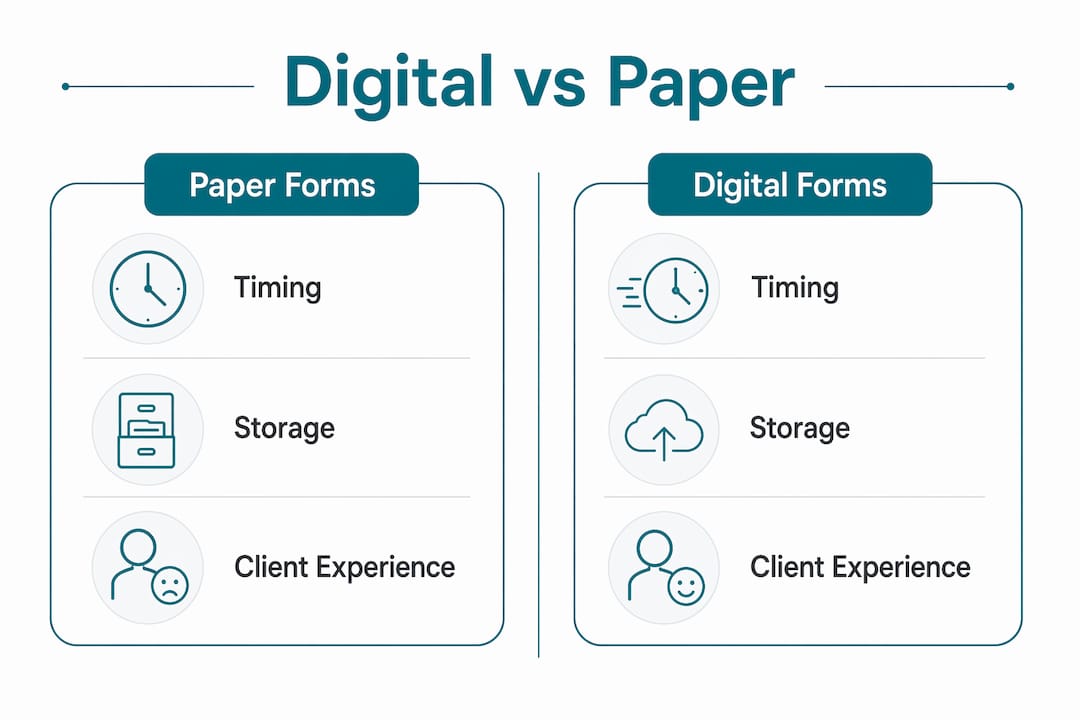
Digital intake forms dramatically reduce back-and-forth communication and save hours of administrative work each week. That time goes back into your art, not your inbox. For studios with multiple artists or more than one location, centralized digital records mean any team member can pull a client’s history in seconds.
Mobile-optimized digital intake builds instant client confidence in ways that paper forms simply cannot. When a client receives a clean, branded form on their phone before their appointment, your studio signals that it operates at a professional level. That first impression shapes how seriously clients take your policies.
Pro Tip: Send the intake form as part of your booking confirmation, not as a separate follow-up. Clients are most engaged right after they book. That is the best moment to capture a completed form.
The biggest pitfall with digital forms is weak enforcement. Without strict enforcement before the session starts, compliance bottlenecks delay operations and increase risk. Require form completion as a condition of the appointment, not a suggestion.
How intake forms improve consultations and reduce disputes
A well-designed tattoo consultation form does more than collect data. It sets the terms of the entire client relationship before anyone touches a needle.
- Fewer no-shows and cancellations. Clients who complete a detailed intake form have invested time and attention in the appointment. That investment increases follow-through. Studios that switch from DMs to standardized forms report reduced no-shows and stronger client commitment.
- Safer tattooing decisions. Health disclosures give you the information you need to decline or modify a session when contraindications are present. Tattooing a client on Accutane without that disclosure on file is a preventable mistake.
- Documented aftercare protection. When aftercare instructions are part of the signed intake form, a client cannot later claim they were never told how to care for the tattoo. That documentation protects you from healing disputes.
- Clearer design alignment. Written design preferences, placement notes, and reference images on file mean both you and the client are working from the same brief. Verbal agreements fade. Signed documents do not.
- Stronger policy enforcement. Consent forms establish legal foundations that clarify risks, aftercare, and refund terms. Clients who signed those terms have far less ground to dispute them later.
The intake form is also your studio’s first tangible professionalism signal. Clients who receive a thorough, well-organized questionnaire before their appointment arrive with a different mindset. They respect the process because the process respects them.
What are the most common intake form mistakes?
Even experienced studios make errors in their intake process. These are the ones that create the most risk.
- Filing forms without reviewing them. A health disclosure is only useful if you read it. Concerning answers require direct dialogue before the session begins, not after. Build a review step into your pre-session workflow.
- Not requiring completion before the appointment. Handing a client a form while they are already in the chair is too late. They rush through it, skip fields, and sign without reading. Require completion in advance as a booking condition.
- Relying on DMs instead of standardized forms. DM communication causes booking fragmentation and reduces your studio’s perceived legitimacy. A client who books through Instagram DMs and never signs a consent form is a liability waiting to happen.
- Missing signed policy agreements. A form that collects health data but does not include a signed acknowledgment of your cancellation, refund, and aftercare policies is incomplete. Every policy your studio enforces needs a client signature to back it up.
Pro Tip: Review your intake form template every six months. Medication lists, health screening criteria, and studio policies change. An outdated form can leave gaps in your legal coverage.
You can explore types of consent forms relevant to tattoo and body modification work to make sure your current template covers every scenario your studio encounters.
Key takeaways
A tattoo client intake form is the single most important document your studio uses to protect clients, protect your business, and set the standard for every session.
| Point | Details |
|---|---|
| Core purpose | Collect health history, identity, design intent, and signed consent before every session. |
| Repeat clients need new forms | Health and medication status change; a prior form does not cover the current session legally. |
| Digital beats paper | Mobile-optimized digital forms improve compliance, professionalism, and legal record-keeping. |
| Enforcement is non-negotiable | Require form completion before the appointment, not during, to avoid compliance gaps. |
| Forms reduce disputes | Signed aftercare instructions and policy acknowledgments protect studios from post-session claims. |
The part most studios get wrong
I have seen studios invest in beautiful digital form tools and then completely undermine the process by letting clients skip completion until they are already in the chair. The form becomes theater. It checks a box without doing any real work.
The intake form is not administrative overhead. It is the foundation of a professional client relationship. When you send a clean, branded questionnaire as part of the booking confirmation, you are telling the client exactly what kind of studio they are walking into. That signal matters more than most artists realize.
What I have found over time is that the studios with the fewest disputes are not necessarily the ones with the most detailed forms. They are the ones that enforce completion consistently and actually review the health disclosures before picking up the machine. A form that gets filed without being read is worse than no form at all, because it creates a false sense of coverage.
The shift to digital intake is worth making, but only if you treat it as a workflow change, not just a technology upgrade. Send the form early. Require completion. Review the answers. Have the conversation when something flags. That sequence is what protects you and your clients.
For studios managing guest artists, the same rules apply. A tattoo guest artist intake form should follow the same pre-appointment workflow as your regular client forms. Guest sessions carry the same legal exposure.
— Artur
How Getconsentify makes tattoo intake simple and secure
Running a professional tattoo studio means your intake process needs to work as well as your art does.
Getconsentify offers digital consent forms for beauty and tattoo studios built specifically for the demands of client-facing wellness and body art businesses. Forms are mobile-optimized, fully branded, and include e-signature capture so every session starts with a legally sound, completed document on file. Clients complete their questionnaire before they arrive, your team reviews it in advance, and your studio’s policies are acknowledged in writing every time. No lost paper forms. No rushed signatures in the chair. Just a clean, professional process that protects everyone involved. See how Getconsentify can work for your studio at getconsentify.com.
FAQ
What is a tattoo client intake form used for?
A tattoo client intake form collects personal identification, health history, design preferences, and signed consent before a session. It protects the studio legally and helps the artist make safe tattooing decisions.
Does a repeat client need to fill out a new intake form?
Yes. Health status, medications, and personal details change over time, and legal consent must be current for each session. A prior form does not provide legal coverage for a new appointment.
What health information should a tattoo intake form include?
The form should ask about allergies, current medications (especially blood thinners and Accutane), bleeding disorders, diabetes, autoimmune conditions, and pregnancy. These factors directly affect healing and tattooing safety.
Are digital tattoo intake forms legally valid?
Yes. Digital forms with e-signatures are legally binding in the United States under the Electronic Signatures in Global and National Commerce Act (E-SIGN Act). They also provide timestamped records that paper forms cannot match.
When should clients receive the intake form?
Clients should receive the intake form at the time of booking confirmation, not on the day of the appointment. Completing it in advance gives you time to review health disclosures and address any contraindications before the session begins.
Recommended
- How Tattoo Digital Forms Work: A Client’s Guide — Consentify
- Send Intake Form Before Appointment: Client Guide — Consentify
- Why Intake Forms Improve Consultations for Beauty Pros — Consentify
- Intake Form for Nail Service Clients: 2026 Guide — Consentify
The Health Screening Fields Every Tattoo Intake Form Needs
Use this checklist to make sure your intake form catches every safety-relevant answer before the needle touches skin:
- Allergies: latex, adhesives, pigments and dyes, antibiotic ointments, soaps, and metals — a latex allergy alone changes your glove choice.
- Medications: blood thinners (aspirin, warfarin, ibuprofen before a session), isotretinoin/Accutane within the last 6–12 months, steroids, and immunosuppressants.
- Medical conditions: bleeding or clotting disorders, diabetes, epilepsy or fainting history, heart conditions, and immune disorders that slow healing.
- Skin conditions at the site: eczema, psoriasis, active acne, sunburn, and a history of keloid scarring.
- Pregnancy or breastfeeding: most studios decline or defer — the form should ask directly.
- Recent alcohol or drug use: affects both consent validity and bleeding.
- Age verification and minor consent: photo ID capture, and a parent/guardian signature flow where local law allows minors.
With a digital intake form, each of these can be a required field — and answers like "blood thinners: yes" can automatically flag the submission for the artist before the session starts.