Why Intake Forms Improve Consultations for Beauty Pros
Discover why intake forms improve consultations for beauty pros. Streamline your process, enhance client experience, and maximize efficiency.

Why Intake Forms Improve Consultations for Beauty Pros

Client intake forms are structured documents that collect health history, preferences, contraindications, and consent information before a consultation begins. For tattoo artists, estheticians, and beauty professionals, they are the single most effective tool for organizing client data upfront and delivering a focused, personalized appointment. The reason why intake forms improve consultations is straightforward: when you know your client before they sit in your chair, you spend less time asking questions and more time doing the work they came for. Platforms like Getconsentify are built specifically for this workflow, giving beauty and tattoo professionals a digital front door that captures everything before the appointment clock starts.
What are the key benefits of using intake forms in client consultations?
The benefits of intake forms reach well beyond saving a few minutes at the front desk. They reshape the entire consultation experience, from the moment a client books to the moment they leave.
Faster check-in, more time for service. Digital intake forms reduce new-client check-in time from 25 minutes down to 5 to 7 minutes. For a busy lash studio or tattoo shop running back-to-back appointments, that recovered time translates directly into revenue and a calmer client experience.

Dramatically fewer errors. Paper forms carry an error rate of roughly 20%, while digital intake drops that figure below 1%. In beauty and tattoo work, a missed allergy or an incorrectly recorded contraindication is not just an administrative inconvenience. It is a safety risk.
Higher client satisfaction. Research shows 81% of clients prefer completing forms digitally, and 76% actively choose providers who offer online forms. Clients who fill out a form at home, on their own schedule, arrive more relaxed and better prepared.
Personalized service from the first appointment. When you collect detailed preferences, skin sensitivities, or style references through an intake form, you can prepare a customized plan before the client walks in. That level of preparation signals professionalism and builds trust immediately.
Reduced billing and administrative errors. 61% of claim denials in service-based industries are linked to errors from manual transcription. Digital forms eliminate the transcription step entirely, keeping your records accurate and your business protected.
Pro Tip: Add a short “anything else we should know?” open-text field at the end of your intake form. Clients often share critical information there that structured questions miss, such as a recent medication change or a sensitivity to a specific fragrance.
How do digital intake forms compare to manual forms?
The difference between paper and digital intake is not just a matter of preference. It is a measurable operational gap.
| Factor | Paper forms | Digital forms |
|---|---|---|
| Check-in time | 20 to 25 minutes | 5 to 7 minutes |
| Data entry error rate | ~20% | Below 1% |
| Form completion timing | At the desk, day of | Before the appointment, at client’s convenience |
| Conditional logic | Not possible | Asks only relevant follow-up questions |
| Integration with scheduling | Manual transfer required | Automated sync with booking and records |
| Consent documentation | Physical storage required | Stored digitally, retrievable instantly |
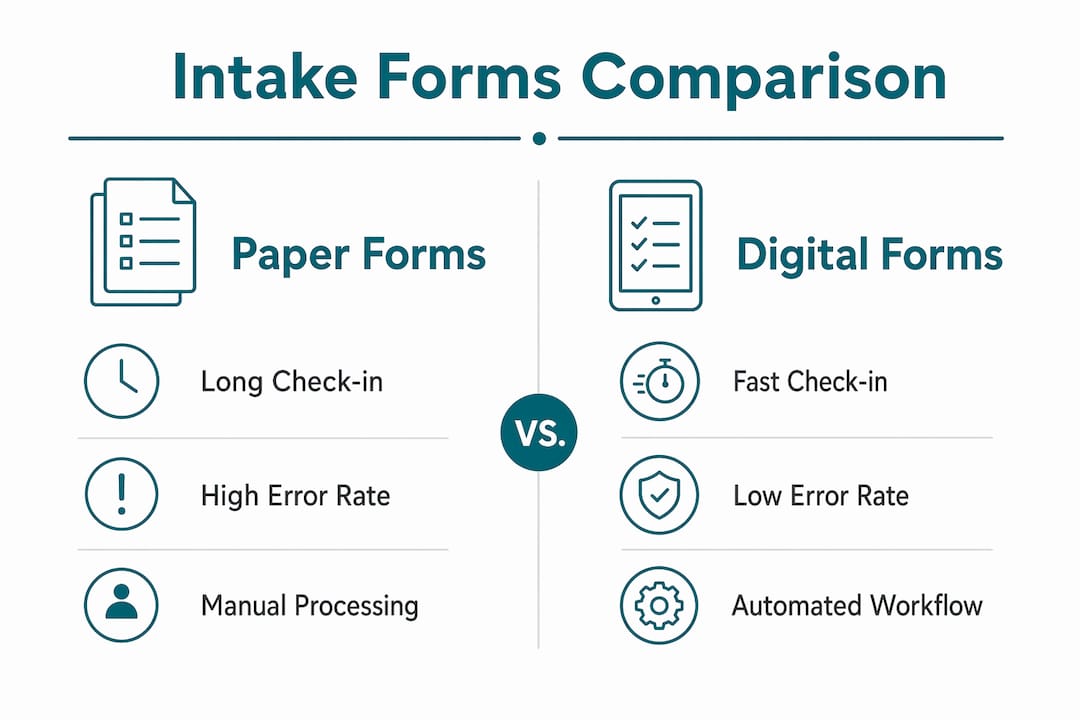
The numbers tell a clear story. Automated verification during intake cuts rejected claims by 70 to 90%, with first-pass resolution rates climbing from 75% to 95%. For beauty clinics and medical spas handling product liability or consent documentation, that accuracy improvement is significant.
Conditional logic is one of the most underused features in digital intake. Rather than presenting every client with a 30-question form, conditional logic tailors questions based on prior answers. A client who selects “no known allergies” skips the allergy detail section entirely. A client who selects “yes” gets the relevant follow-up questions. This keeps completion rates high and data quality sharp.
Integration with scheduling and client management systems removes the manual transfer step entirely. When intake data flows directly into your records, you eliminate the lag between form submission and consultation preparation. That is how intake becomes clinical infrastructure rather than paperwork.
What design strategies make intake forms more effective?
A poorly designed intake form creates friction. Clients abandon it, rush through it, or give vague answers. A well-designed form gets completed before the appointment and gives you exactly what you need. Here is how to build one that works for beauty and tattoo consultations specifically.
-
Keep it focused. Remove any question that does not directly inform your service or protect your client. A tattoo consultation form does not need a client’s employer information. An esthetician’s form does not need a full medical history unless specific treatments require it. Every unnecessary question reduces completion rates.
-
Use conditional fields. If a client indicates they have had a patch test reaction before, follow up with specifics. If they have not, move on. Conditional logic prevents form fatigue and keeps the experience relevant to each individual client.
-
Include consent and contraindication sections. For tattoo artists, this means documenting blood-thinning medications, skin conditions, and aftercare acknowledgment. For estheticians, it means capturing known sensitivities to ingredients like retinol, AHAs, or specific fragrance compounds. These fields protect both the client and your business.
-
Build in multilingual and accessibility options. A diverse client base means some clients are more comfortable in Spanish, Mandarin, or another language. Offering multilingual forms is not just a courtesy. It directly improves the accuracy of the information you receive.
-
Send the form before the appointment. Pre-visit form completion rates can exceed 65% when forms are sent at the right time, typically 24 to 48 hours before the appointment. Clients who complete forms in advance allow you to review their information and prepare a tailored plan before they arrive. For guidance on timing and delivery, the send-before-appointment guide from Getconsentify covers the mechanics in detail.
Pro Tip: Send your intake form link in the booking confirmation message. Clients are already engaged with your brand at that moment, and the completion rate is significantly higher than a separate follow-up message sent later.
How can intake forms improve client-provider communication?
The importance of client intake forms becomes most visible during the consultation itself. When you already have a client’s preferences, health notes, and style references in front of you, the conversation shifts from data collection to genuine dialogue.
-
No redundant questions. Structured intake eliminates repeated questioning during the visit, freeing the consultation to focus on creative direction, treatment planning, and client concerns. Clients notice when you already know their history. It builds confidence in your professionalism.
-
Tailored treatment plans prepared in advance. A tattoo artist who reviews a client’s skin type, placement preferences, and reference images before the session can arrive with a refined design concept rather than starting from scratch. An esthetician who knows a client’s current skincare routine and past reactions can recommend a targeted facial protocol without a lengthy intake interview.
-
Better documentation for consistency. When intake data feeds directly into your client records, every future appointment benefits from that history. You know what worked, what caused sensitivity, and what the client’s preferences are. That continuity is what turns a one-time visitor into a loyal client.
-
Reduced service errors. The importance of client intake forms for error prevention is well documented. Knowing a client is on blood thinners before a tattoo session, or that they are sensitive to a specific wax ingredient, prevents incidents that damage trust and expose your business to liability.
-
Personalization that clients feel. Beauty and tattoo clients pay for expertise and experience. When your consultation opens with “I saw you prefer a natural finish and you mentioned sensitivity to fragrance,” that client feels seen. Intake forms are the mechanism that makes that personalization possible at scale.
For a deeper look at how this plays out in beauty-specific workflows, the intake forms for beauty salons guide covers the practical setup in detail.
Key takeaways
Intake forms improve consultations by eliminating guesswork, reducing errors, and giving providers the client data they need to deliver personalized, safe, and efficient services from the first appointment.
| Point | Details |
|---|---|
| Time savings are measurable | Digital intake cuts check-in from 25 minutes to 5 to 7 minutes, recovering billable time. |
| Error rates drop sharply | Paper forms carry a 20% error rate; digital forms reduce that to below 1%, protecting clients and providers. |
| Pre-appointment delivery matters | Sending forms 24 to 48 hours before the appointment pushes completion rates above 65%. |
| Conditional logic improves data quality | Tailoring questions based on prior answers reduces form fatigue and increases the accuracy of responses. |
| Personalization builds loyalty | Clients who feel known and prepared for return. Intake data is the foundation of that relationship. |
Why most beauty pros are still leaving money on the table
I have worked with enough tattoo artists and estheticians to know the most common objection: “My clients don’t want to fill out forms.” That belief is costing people real money. The data is clear that clients prefer digital forms and actively choose providers who offer them. The resistance is usually on the provider’s side, not the client’s.
The second mistake I see is treating intake as a one-time setup task. The best intake forms evolve. A tattoo shop that added a question about recent sun exposure to their form after a client had a reaction during healing turned a near-miss into a permanent safety protocol. That is the kind of institutional knowledge that only gets captured when intake is treated as living documentation.
The ROI argument that gets overlooked most often is billing accuracy. Most beauty professionals think about intake in terms of front-desk efficiency. But the biggest return from digital intake often comes from downstream error reduction, fewer disputes, cleaner records, and stronger consent documentation. That is the argument that should be driving adoption, and it rarely gets made.
My honest advice: start with three to five questions that directly affect your service safety, add consent language, and send it before the appointment. You will see the difference in your first week.
— Artur
See how Getconsentify handles intake for beauty and tattoo pros
Getconsentify builds digital intake forms specifically for beauty salons, tattoo shops, and medical spas. The forms are branded, mobile-friendly, and designed to be completed before the appointment so you walk into every consultation fully prepared. Conditional logic, consent capture, and allergy documentation are built in from the start. Whether you run a solo lash studio or a multi-artist tattoo shop, Getconsentify gives you the client data you need without the paper trail. Explore the tattoo shop intake solution or the beauty and wellness forms to see what a purpose-built intake system looks like for your industry.
FAQ
What are intake forms used for in beauty consultations?
Intake forms collect client health history, allergies, contraindications, preferences, and consent before a beauty or tattoo appointment. They give the provider the information needed to deliver a safe, personalized service without relying on verbal questioning during the session.
How do intake forms reduce errors in tattoo and beauty services?
Digital intake forms reduce data entry errors from roughly 20% on paper to below 1% digitally. For tattoo and beauty professionals, this means fewer missed contraindications, more accurate consent records, and a lower risk of adverse reactions during treatment.
When should I send an intake form to a client?
Send the intake form 24 to 48 hours before the appointment. Pre-visit completion rates exceed 65% when forms are delivered at booking confirmation or in a timely reminder, giving you time to review and prepare before the client arrives.
Do clients actually prefer digital intake forms over paper?
Yes. Research shows 76% of clients choose providers who offer online intake forms, and 81% prefer completing them digitally. Clients value the flexibility of filling out forms at home on their own schedule rather than at the front desk.
What questions should a tattoo intake form include?
A tattoo intake form should cover skin conditions, blood-thinning medications, recent sun exposure, known allergies, placement preferences, and aftercare acknowledgment. Consent language confirming the client understands the procedure and its risks is required for legal protection and professional documentation.