Intake Form for Nail Service Clients: 2026 Guide
Discover the essential intake form for nail service clients in 2026. Ensure personalized care and legal protection with our comprehensive guide!

Intake Form for Nail Service Clients: 2026 Guide

A client intake form for nail service clients is a structured questionnaire that collects health history, treatment preferences, and consent acknowledgments before any nail service begins. Unlike a consent form, which captures agreement to specific treatment risks, an intake form establishes a baseline of client health and personal information that informs every service decision you make. Nail professionals who skip this step are flying blind. They miss contraindications, lose legal protection, and deliver generic services when clients expect personalized care. This guide covers what to include, how to build the form into your booking flow, and the screening questions that protect both your clients and your salon.
What should an intake form for nail service clients include?
A well-built nail service client questionnaire covers six core categories. Each one serves a distinct purpose, and leaving any out creates gaps that can lead to service complications or liability exposure.
- Personal information: Full name, date of birth, phone number, and email address. This data anchors every client record and enables follow-up communication.
- Medical history relevant to nail care: Conditions like diabetes, peripheral neuropathy, immune disorders, and blood-clotting issues directly affect how you approach pedicure services and cuticle work. A client with diabetes, for example, requires extra caution around any skin or cuticle cutting due to slower wound healing.
- Medications and allergies: Certain medications thin the blood or increase skin sensitivity. Allergy disclosures protect against reactions to acrylics, gel adhesives, and nail polish ingredients.
- Nail health screening questions: Ask about discoloration, thickening, crumbling, fungal infection signs, and any recent trauma to the nails or surrounding skin. These are the questions that separate a professional nail salon from a walk-in shop.
- Service preferences and goals: Preferred nail length, shape, finish, and any past reactions to specific products. This section turns a standard manicure into a personalized experience.
- Consent and acknowledgment statements: A declaration confirming the client has provided accurate information and agrees to notify the salon of any health changes before future visits.
Standardized intake form categories recommended by Pabau distinguish clearly between health screening and consent, keeping documentation clean and legally defensible. This separation matters because mixing the two creates confusion about what the client actually agreed to and what was simply disclosed.
Pro Tip: Add a short privacy disclaimer directly above the signature field. Clients are more likely to disclose sensitive health information when they know it stays confidential and is used only to improve their service.

How to integrate intake forms into your nail salon booking flow
Getting the form built is only half the work. How and when you deliver it determines whether clients actually complete it before they arrive.
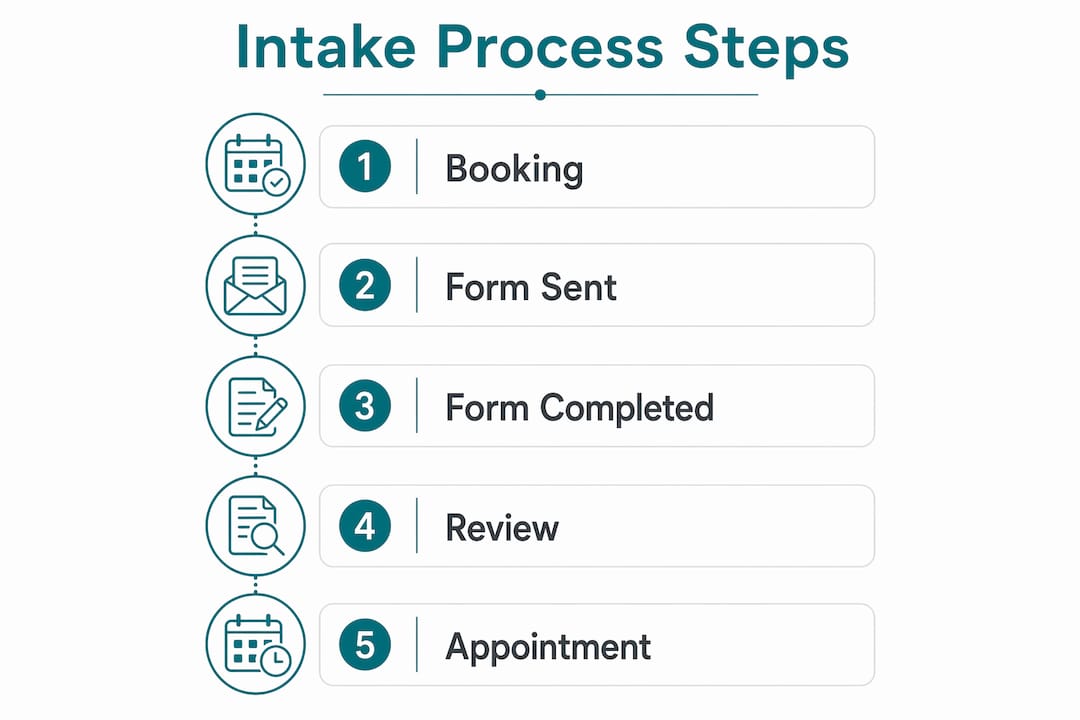
- Embed the form in your booking confirmation. Send the nail services registration form as a link immediately after a client books. Platforms with digital form capabilities let you attach the form to the booking confirmation email automatically, so no manual follow-up is needed.
- Set a completion window of at least 24 hours before the appointment. Intake forms placed pre-appointment reduce back-and-forth during the service and give you time to review responses and prepare. A client who discloses a fungal infection on their intake form can be contacted before they arrive, saving both parties time.
- Use conditional logic to keep the form concise. If a client answers “no” to having any nail health concerns, they skip the detailed screening section. This keeps the manicure client information form from feeling like a medical questionnaire for healthy clients, while still capturing full detail when it matters.
- Sync responses to your client records. Every completed form should feed directly into the client’s profile in your appointment software. This creates a searchable history that informs future services and supports continuity of care.
- Train your staff to review intake responses before each appointment. A technician who reads the intake form before a client sits down can prepare the right tools, avoid contraindicated techniques, and open the appointment with informed questions rather than generic small talk.
Digital intake forms reduce in-clinic waiting and documentation time by up to 75%, according to Pabau. That figure reflects the cumulative time saved when clients complete paperwork before arrival rather than filling out paper forms at the front desk.
Pro Tip: Offer the pedicure service intake questions and manicure sections as separate short forms if your salon offers both. Clients booking only a manicure do not need to answer foot health questions, and shorter forms get completed at higher rates.
What nail health screening questions should technicians ask?
Nail health screening is where a professional nail salon intake process separates itself from a basic client information sheet. These questions function as a triage system. When a client reports specific symptoms, you pause cosmetic service and refer them to a medical provider rather than proceeding and potentially worsening a condition.
The following questions belong on every nail care service details form:
- Nail appearance changes: “Have you noticed any discoloration, thickening, or crumbling of your nails in the past three months?” Yellow, brown, or white patches under the nail plate are common signs of onychomycosis, a fungal infection that contraindicates most nail services.
- Pain or discomfort: “Do you experience any pain, tenderness, or sensitivity around your nails or nail beds?” Pain can indicate infection, ingrown nails, or underlying circulatory issues.
- Recent trauma: “Have you had any recent injuries to your nails, fingers, or toes?” Trauma disrupts the nail plate and surrounding tissue, making certain services unsafe until healing is complete.
- Immune and blood conditions: “Do you have any conditions that affect your immune system or blood circulation?” Clients with compromised immunity are at higher infection risk from any service that involves cuticle work or skin contact.
- Exposure risk factors: “Do you regularly use communal showers, pools, or wear tight footwear for extended periods?” These are primary risk factors for fungal infections and should prompt closer visual inspection before service.
Nail Care Hub’s 2026 guidance recommends that nail health screening questions guide a clear decision tree: if a client reports discoloration, pain, or fungal signs, the technician pauses cosmetic service and refers the client to a physician before proceeding.
For returning clients, routine screening every six months catches new infections or health changes that would not appear on an older intake form. Health conditions change, and a form completed 18 months ago does not reflect a client who has since developed diabetes or started immunosuppressant medication.
Common mistakes nail salons make with client intake forms
Most intake form problems fall into a small number of predictable categories. Knowing them in advance saves you from building a form that looks professional but fails in practice.
- Conflating intake and consent forms. Katy Piper at Pabau makes this point directly: intake versus consent forms serve different legal and clinical functions. An intake form collects health information. A consent form documents the client’s agreement to specific risks associated with a specific treatment. Combining them into one document blurs both purposes and weakens your legal position.
- Making the form too long. Focused, relevant forms get completed. A 40-question nail salon client intake form that asks about conditions unrelated to nail services will see abandonment rates climb. Match every question to a specific service decision you need to make.
- Skipping the client declaration. The declaration at the end of the form is not a formality. Intake declarations create a documented baseline and a legal record of client health disclosures. Treat it as an evidence trail, not a checkbox.
- Using paper forms without a digital backup. Paper forms get lost, damaged, and cannot be searched. Digital platforms with e-signature capabilities and conditional logic protect client data and make records retrievable during audits or disputes.
- Never updating forms for returning clients. A new client form for nail salon visits should not be the last form a client ever completes. Health changes, medications change, and nail conditions evolve. Build a re-screening trigger into your system for clients who have not updated their information in six months.
Matching intake questions to technician workflow keeps forms short and purposeful. Every question that does not directly inform a service decision is a question that reduces completion rates without adding safety value.
Key takeaways
A structured nail service intake form is the single most effective tool for protecting clients, reducing liability, and delivering personalized nail care at a professional level.
| Point | Details |
|---|---|
| Separate intake from consent | Intake forms collect health data; consent forms document treatment agreement. Keep them as distinct documents. |
| Screen nail health specifically | Ask about discoloration, pain, trauma, and immune conditions to identify contraindications before service begins. |
| Integrate into booking flow | Send forms 24+ hours before appointments so technicians can review responses and prepare appropriately. |
| Update returning client records | Re-screen clients every six months to catch new health changes that affect service safety. |
| Use digital tools with e-signatures | Digital platforms protect data, enable conditional logic, and create legally defensible records automatically. |
Why intake forms are the most underrated tool in nail salon professionalism
I have reviewed intake processes across dozens of nail and beauty businesses, and the pattern is consistent. Salons that invest in a well-designed intake process retain clients longer, receive fewer complaints, and handle difficult situations with far more confidence. The ones that skip it or use a generic paper form tend to find out why it matters only after something goes wrong.
What strikes me most is how much the intake form communicates before a single word is spoken in the appointment. A client who receives a professional, clearly worded nail service client questionnaire before they arrive already has a different expectation of the salon. They expect precision. They expect that their health history will be used, not ignored. That expectation shapes the entire service experience.
The deeper insight is this: the intake form is not primarily a legal document. It is a communication tool. When you ask a client about their nail health, their preferences, and their medical history, you are telling them that you take their safety seriously. That message builds the kind of trust that turns a first appointment into a long-term client relationship.
My advice is to treat your intake form as a living document. Review it every six months. Add questions when you introduce new services. Remove questions that no longer connect to a service decision. The form that served you well when you offered basic manicures may need significant updates if you add gel extensions, nail art, or pedicure treatments for diabetic clients.
— Artur
How Getconsentify makes nail salon intake effortless
Getconsentify builds digital intake forms designed specifically for beauty and wellness professionals. You can customize your nail service intake form with conditional logic, e-signature fields, and branded design, then embed it directly into your booking confirmation flow. Client responses sync to their records automatically, so your technicians walk into every appointment prepared. Getconsentify handles data security and compliance so you can focus on delivering exceptional nail care. If you are ready to replace paper forms and manual follow-ups with a professional digital intake process, Getconsentify is built for exactly that.
FAQ
What is a client intake form for nail services?
A client intake form for nail services is a structured questionnaire completed before an appointment that collects health history, nail condition details, allergies, and service preferences. It gives nail technicians the information needed to personalize services and identify contraindications safely.
How is an intake form different from a consent form?
An intake form collects baseline health and preference information, while a consent form documents a client’s agreement to the specific risks of a treatment. Pabau’s guidance confirms these should always be kept as separate documents to maintain clear legal and clinical records.
What nail health questions should be on an intake form?
Ask about nail discoloration, thickening, crumbling, pain, recent trauma, fungal infection signs, and any immune or circulatory conditions. Nail Care Hub recommends these questions as the basis for deciding whether to proceed with cosmetic nail services or refer the client to a physician.
How often should returning clients complete a new intake form?
Returning clients should update their intake information at least every six months. Health conditions, medications, and nail health can change significantly, and an outdated form does not protect the client or the salon.
Can I send a nail salon intake form before the appointment?
Yes, and you should. Sending the form 24 hours or more before the appointment allows clients to complete it without time pressure and gives technicians time to review responses and prepare for the service.