The Role of Before-After Photo Consent for Beauty Pros
Discover the crucial role of before-after photo consent for beauty pros. Learn the legalities that protect your business and clients.

The Role of Before-After Photo Consent for Beauty Pros

Before-after photo consent is a mandatory legal and ethical agreement that authorizes the use of client images for both clinical documentation and marketing purposes. For beauty professionals and tattoo artists, understanding the role of before-after photo consent is not optional. HIPAA classifies client photos as protected health information (PHI), and unauthorized use can trigger fines from $100 to $50,000 per incident. Regulatory bodies like AHPRA enforce equally strict standards. Getting consent right protects your business, respects your clients, and keeps your marketing legally sound.
What legal regulations govern before-after photo consent in 2026?
Photo consent sits at the intersection of privacy law, healthcare regulation, and marketing ethics. Three major frameworks shape what beauty professionals and tattoo artists must do in 2026.
HIPAA (United States)

HIPAA classifies client photos as PHI when they connect an individual to a specific treatment. Unauthorized photo use can trigger fines from $100 to $50,000 per incident, with annual maximums of $1.5 million per violation category. That range reflects severity, from accidental disclosure to willful neglect. HIPAA enforcement actions targeting social media marketing photo use have increased in 2026, meaning regulators are actively watching how clinics and studios post client images online.
AHPRA (Australia)
AHPRA enforces granular, separate marketing consent with specific use cases. AHPRA penalties for failing to maintain compliant marketing consent can reach $60,000 per offense for individuals. That figure applies per image, per violation. Practitioners who bundle photo consent into a general treatment form do not meet AHPRA’s standard.
GDPR (European Union and UK)
GDPR requires a lawful basis for processing personal data, and photos qualify as personal data. By 2026, the expected standard for marketing use of photos is informed, granular, documented consent rather than relying on “legitimate interest” as legal justification. That shift matters for any practitioner with international clients or a global social media presence.
What every compliant consent process must include:
- A standalone marketing photo release form, separate from treatment consent
- Explicit listing of all intended use channels (website, social media, print, email)
- Client signature confirming informed, voluntary agreement
- Retention of consent documents for at least 7 years
- A clear process for honoring client requests to withdraw consent
Verbal consent and bundled intake forms do not meet legal standards in any of these frameworks. Written, documented consent is the only defensible position.
Why is granular, informed consent critical beyond legal compliance?
Legal compliance sets the floor. Ethical practice raises the ceiling. The distinction matters because clients who feel respected are more likely to say yes to photo use, and more likely to refer others to your business.
Separating marketing consent from treatment consent is a best practice, not just a legal requirement. Marketing consent bundled with clinical forms jeopardizes compliance because clients must have a genuine opt-in that does not affect their treatment. When a client feels that refusing photo consent might change how you treat them, the consent is no longer truly voluntary. That invalidates it legally and damages trust ethically.
Client autonomy during photography also matters. Some clients are comfortable with full-face images on Instagram. Others want only cropped, non-identifiable shots used in print materials. Respecting those preferences is not a burden. It is the foundation of a professional relationship. Practitioners who treat photography ethics as a creative guardrail report deeper client trust and better long-term satisfaction.
Reputational risk is real and fast-moving. A single social media post using a client’s image without clear consent can generate complaints, negative reviews, and regulatory investigations within hours. The legal aspects of photo consent and the ethical aspects are inseparable in practice.
Pro Tip: Ask clients about their comfort level with photo use during the consultation, before you even mention a consent form. That conversation makes the formal consent feel like a natural next step, not a legal hurdle.
What are the best practices for obtaining, documenting, and managing before-after photo consent?
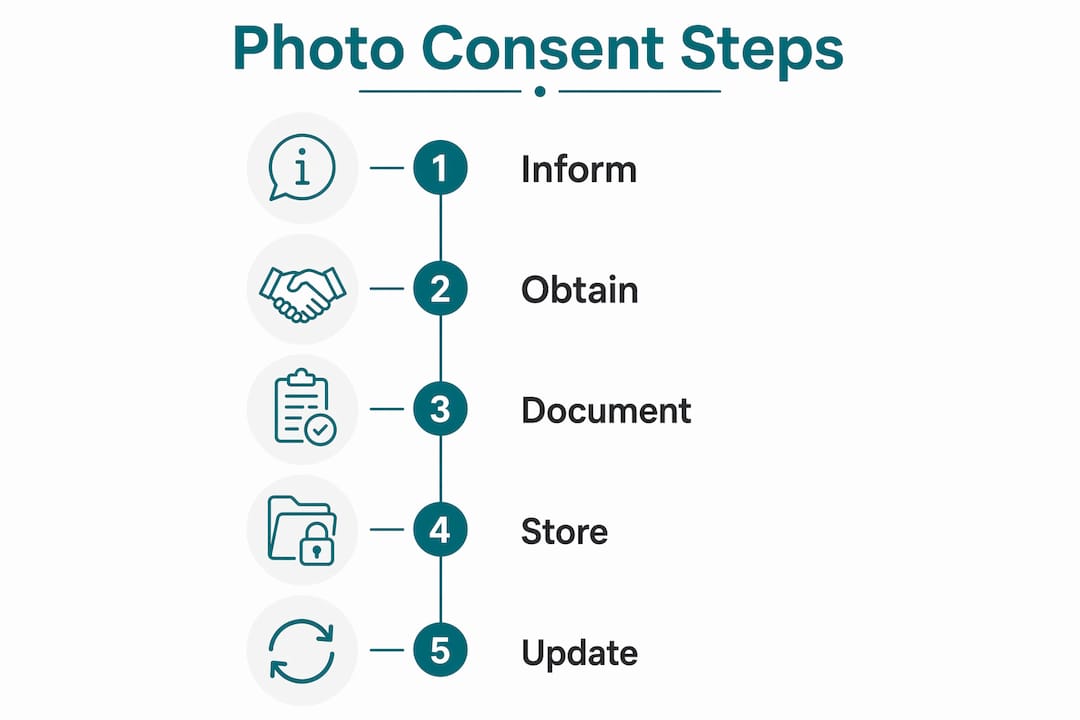
Getting consent right requires attention to timing, documentation, storage, and client rights. Here is a practical framework for beauty professionals and tattoo artists.
-
Time consent after final results are visible. Obtaining marketing consent after treatment outcomes are visible leads to informed decisions and reduces the risk of invalid consent. For facial treatments, that often means waiting 8–12 weeks post-procedure. For tattoos, it means waiting until the piece is fully healed and the client can see the finished work. Consent signed before a client knows the outcome is consent signed without full information.
-
Use a standalone photo release form. The form must be separate from your general treatment or intake paperwork. It should specify every channel where you intend to use the image: your website, Instagram, Facebook, print advertising, email newsletters, and any other platform. Each photo’s marketing consent must be tracked granularly, specifying permitted platforms and respecting client restrictions for each.
-
Standardize your photo conditions. Consistent lighting, angles, and backgrounds make before-after images more useful clinically and more compelling for marketing. Document the camera settings and environment so every photo set is comparable. This also protects you if a client later disputes the accuracy of an image.
-
Store images in encrypted, compliant systems. Storing patient photos on personal devices without encryption violates privacy regulations and risks data breaches. Upload images immediately to a HIPAA-compliant or encrypted image management system. Personal phones and unencrypted cloud folders are not acceptable storage locations, regardless of whether consent was signed.
-
Retain consent records for at least 7 years. Professional guidelines require standalone, explicit marketing photo release forms with retention for at least 7 years. That timeline aligns with standard medical records retention requirements and protects you in the event of a delayed complaint or audit.
-
Honor withdrawal requests promptly. Clients have the right to revoke consent at any time. When they do, remove the images from all specified channels without delay. Document the withdrawal request and your response. Failure to act on a revocation is a separate violation from the original consent issue.
Pro Tip: Use a digital consent system that timestamps each signature and logs every update. A tamper-proof audit trail is your best defense in a regulatory review or client dispute.
For tattoo artists, the tattoo client intake process should include a dedicated photo consent section that covers both portfolio use and social media posting, since those are the two most common channels for tattoo artists.
How to handle common misunderstandings about photo consent
Several persistent misconceptions put beauty professionals and tattoo artists at legal and reputational risk. Knowing them in advance keeps you out of trouble.
-
“Non-identifiable photos don’t need consent.” This is wrong. Photos without identifiable facial features still require consent because images can qualify as PHI when they link an individual to a specific medical or cosmetic treatment. A cropped photo of a client’s abdomen after a body contouring treatment is still protected information.
-
“Verbal consent is enough.” Verbal consent has no evidentiary value in a regulatory investigation. Written, signed documentation is the only standard that holds up.
-
“Our general intake form covers photos.” Bundled consent does not meet legal standards under HIPAA, AHPRA, or GDPR. Regulators treat bundled forms as no consent at all for marketing purposes.
-
“We got consent before the treatment, so we’re covered.” Consent obtained before a client sees their results may not be valid. Informed consent requires the client to understand what they are agreeing to, and that includes knowing the outcome.
-
“We only post on Instagram, so we don’t need to list other channels.” If you later use the image in a print ad or email campaign, you need a new or updated consent form. Consent is channel-specific.
Treating photo consent as a one-time checkbox is the most common mistake practitioners make. Consent is an ongoing relationship with your client, not a document you file and forget. Every new use case requires a fresh conversation and, often, a fresh signature.
Updating your client intake forms regularly is one of the most effective ways to stay ahead of these pitfalls as regulations evolve.
Key Takeaways
Before-after photo consent is a legally required, channel-specific agreement that must be documented in writing, stored securely, and honored when clients withdraw it.
| Point | Details |
|---|---|
| Consent is legally mandatory | HIPAA, AHPRA, and GDPR all require written, documented consent for marketing photo use. |
| Separate forms for marketing | Marketing photo consent must be a standalone form, not bundled with treatment intake paperwork. |
| Time consent after results | Obtain photo consent after final outcomes are visible so clients can make a fully informed decision. |
| Store images securely | Use encrypted, HIPAA-compliant systems. Personal devices and unencrypted platforms are not compliant. |
| Honor withdrawal requests | Remove images from all channels promptly when a client revokes consent, and document the action. |
Photo consent changed how I run my practice
I used to think a signed intake form covered everything. It took one uncomfortable conversation with a client who recognized herself in an Instagram post to make me rethink that entirely. She had signed a general form at her first appointment, months before her treatment was finished. She had no idea her photo would end up on social media. She was not angry. She was hurt. That distinction stuck with me.
The legal frameworks are real and the penalties are serious. But the more lasting lesson was about the relationship. Clients share something personal when they let you photograph their bodies or their skin. That trust is not a given. You earn it by being explicit about what you plan to do with those images, when, and where.
What I have found works best is treating the photo consent conversation as part of the aftercare discussion. By that point, the client is happy with their results, they feel good about the work, and they are far more likely to say yes. More importantly, they understand exactly what they are agreeing to. That is the difference between consent that is legally valid and consent that is genuinely informed.
The practitioners I respect most in this industry treat photo consent as a professional standard, not a legal burden. They build it into their workflow the same way they build in patch tests or aftercare instructions. It becomes invisible because it is just part of how they operate.
— Artur
Consentify makes photo consent simple and compliant
Managing before-after consent agreements across dozens of clients is hard to do consistently with paper forms or generic digital documents. Consentify gives beauty professionals and tattoo artists purpose-built digital consent forms that separate marketing photo release from treatment consent, specify permitted channels, and store every signature with a tamper-proof audit log.
Consentify uses AI to convert your existing PDF forms into editable digital documents. Clients complete and sign them on their own devices via QR code, with no app download required. Military-grade encryption keeps every image and signature secure. If you work in a medspa environment, Consentify’s medspa consent tools are built specifically for the clinical-grade compliance standards your practice requires.
FAQ
What is before-after photo consent?
Before-after photo consent is a written, signed agreement in which a client explicitly authorizes a practitioner to use images of them for specified purposes, such as clinical records or marketing, on named channels.
Do non-identifiable photos require consent?
Yes. Photos without visible facial features still qualify as protected health information when they link an individual to a specific treatment, so written consent is required regardless of identifiability.
How long must photo consent records be kept?
Professional guidelines require retention of standalone marketing photo release forms for at least 7 years, aligning with standard medical records requirements.
Can I bundle photo consent with my general intake form?
No. Bundled consent does not meet legal standards under HIPAA, AHPRA, or GDPR. Marketing photo consent must be a separate, standalone document with a genuine opt-in choice.
What happens if a client withdraws photo consent?
Remove the images from every channel specified in the consent form promptly, and document both the withdrawal request and your response to protect yourself in any future audit or dispute.