Salon Intake Form GDPR Compliance: 2026 Guide
Ensure your salon intake form GDPR compliance for 2026. Protect your business, maintain client trust, and meet legal requirements effectively.

Salon Intake Form GDPR Compliance: 2026 Guide

A salon intake form that meets GDPR requirements is a legal document that collects client data with full transparency, a valid lawful basis, and documented consent where required. Every UK salon storing client information digitally falls under the General Data Protection Regulation, enforced by the Information Commissioner’s Office (ICO). Getting this right protects your business from regulatory fines, safeguards client trust, and gives you a defensible paper trail if a dispute arises. This guide covers the legal foundations, required form elements, a step-by-step setup process, and the mistakes that put salons at risk.
What legal requirements must a salon intake form meet under GDPR?
GDPR sets out six lawful bases for processing personal data, and salon owners must identify the correct one for each data category they collect. For routine client information like contact details and treatment history, contractual necessity or legitimate interests are more stable legal bases than consent. Consent as a lawful basis is often misused; it is best reserved for special category data and marketing communications. Relying on consent for everything creates a fragile compliance structure, because clients can withdraw it at any time.
Special category data includes health conditions, allergies, and contraindications. This type of data requires explicit, prior, documented consent before you process it. Verbal confirmation or a general privacy policy does not meet this standard. Your intake form must include a specific, unticked consent checkbox for each special category data purpose.

Most salons storing client data digitally must also register with the ICO. ICO registration costs around £52 per year and takes approximately 15 minutes to complete. Many salon owners wrongly assume their size exempts them from GDPR. The ICO fee exemption is narrow and does not remove any other GDPR obligations, including security, transparency, and client rights.
Your clients also hold Subject Access Rights. Salons must respond to Subject Access Requests within one calendar month. That means you need a system to locate, retrieve, and deliver a client’s data quickly. Paper-based records make this difficult. Digital systems make it manageable.
Pro Tip: Keep a simple register of your lawful bases by data category. For example: “Contact details: contractual necessity. Allergy information: explicit consent. Marketing emails: consent.” This one-page document becomes your first line of defense in any ICO inquiry.
Which client data fields should a GDPR-compliant salon intake form include?
Your intake form should collect only the data you genuinely need for the services you provide. This principle, called data minimization, is a core GDPR requirement. A salon intake form fields checklist typically covers the following categories:
- Personal contact details. Full name, phone number, and email address. These are processed under contractual necessity.
- Treatment history. Previous services, reactions, and relevant medical background. This supports safe service delivery and falls under contractual necessity or legitimate interests.
- Allergy and contraindication information. Skin sensitivities, medications, and health conditions relevant to treatments. This is special category data requiring explicit consent.
- Patch test records. Date, product used, and result. Patch test records should be stored for at least 3 years. This protects both the client and your business.
- Marketing consent. A separate, unticked checkbox for email or SMS marketing. Never bundle this with service consent.
- Photo consent. A separate, unticked checkbox for before-and-after photos used in marketing. Explicit documented consent is required before taking client photos, and clients must be told exactly where images will appear.
Your form must also state how long you will keep each data type. The standard practice is to retain contact and treatment history data for the duration of the client relationship plus 6 years. This aligns with standard limitation periods for civil claims.
| Data type | Lawful basis | Retention period |
|---|---|---|
| Contact details | Contractual necessity | Relationship + 6 years |
| Treatment history | Contractual necessity | Relationship + 6 years |
| Allergy and health info | Explicit consent | Relationship + 6 years |
| Patch test records | Explicit consent | Minimum 3 years |
| Marketing consent | Consent | Until withdrawn |
| Client photos | Explicit consent | Until withdrawn |
Pro Tip: Never use pre-ticked consent boxes. GDPR requires consent to be a clear, affirmative action. A pre-ticked box does not meet that standard and will not hold up under regulatory review.
How to create a GDPR-compliant salon intake form step by step
A well-built compliance process follows a clear sequence. Skipping steps creates gaps that regulators and clients can exploit.
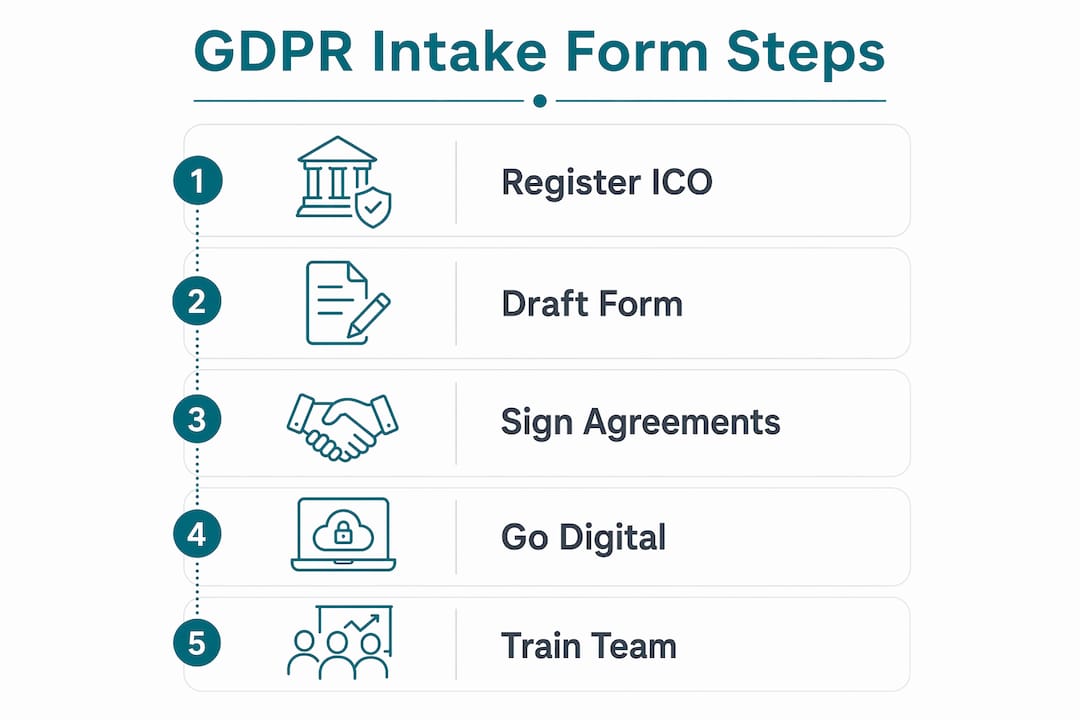
Step 1: Register with the ICO and prepare your privacy notice. Register at ico.org.uk before you collect any client data digitally. Then write a plain-English privacy notice that explains what data you collect, why you collect it, how long you keep it, and who you share it with. This notice must be accessible before a client fills in any form.
Step 2: Draft your intake form with transparent fields and explicit consent checkboxes. Use separate, unticked checkboxes for each consent purpose. Do not combine allergy consent with marketing consent in a single checkbox. Consent records must include a timestamp, the exact wording of the consent text, and the specific purpose agreed. This level of detail is what protects you during a regulatory review or client dispute.
Step 3: Sign data processing agreements with every third-party provider. If you use a booking system, CRM, or digital form platform, you are legally required to have a signed Data Processing Agreement (DPA) in place. DPAs are mandatory under GDPR Article 28 and must define processing scope, security measures, breach notification procedures, and audit rights. A general privacy policy from your software provider does not satisfy this requirement.
Step 4: Move to a digital intake system for secure storage and SAR compliance. Paper forms cannot be encrypted, searched, or audited efficiently. Digital consent forms with e-signatures create tamper-proof records that are far easier to retrieve when a client submits a Subject Access Request. Digital systems also reduce the risk of forms being lost, damaged, or seen by unauthorized staff.
Step 5: Train your team on GDPR basics and data confidentiality. Every staff member who handles client data is a potential compliance risk. Training does not need to be lengthy. A 30-minute briefing on what data you collect, who can access it, and how to handle a client data request covers the core obligations. Document that training took place.
Common mistakes that put salon GDPR compliance at risk
Most compliance failures in salons come from a small set of repeated errors. Recognizing them is the fastest way to fix your current process.
- Relying on verbal consent for special category data. A client saying “yes, that’s fine” before a patch test does not constitute documented consent. You need a signed, dated record with the specific purpose stated.
- Using pre-ticked consent boxes. This is one of the most common errors on downloaded templates. Most free salon consultation form templates lack essential GDPR statements and often include pre-ticked boxes that invalidate consent entirely.
- Failing to sign DPAs with software providers. Many salon owners assume their booking software handles compliance automatically. It does not. You remain the data controller, and you need a signed DPA from every processor you use.
- Ignoring data deletion obligations. GDPR gives clients the right to request deletion of their data. If you cannot locate and delete a specific client’s records, you are in breach. A digital system with searchable records solves this directly.
- Overusing consent as your lawful basis. Consent is the right basis for marketing and photos. For routine treatment data, contractual necessity is more appropriate and more stable. Misapplying consent creates unnecessary withdrawal risk.
“The biggest compliance gap I see in salons is not malicious. It is a genuine misunderstanding of what consent actually means under GDPR. Salon owners think ticking a box on a paper form is enough. It is not. The record of that consent, including when it was given and for what exact purpose, is what matters.”
Key takeaways
A GDPR-compliant salon intake form requires the correct lawful basis for each data type, explicit documented consent for special category data, a signed DPA with every software provider, and a digital system that supports fast Subject Access Request responses.
| Point | Details |
|---|---|
| Choose the right lawful basis | Use contractual necessity for routine data; reserve explicit consent for health info and marketing. |
| Document every consent event | Record timestamp, purpose, and exact consent wording for each client agreement. |
| Register with the ICO | Most salons storing digital client data must register; the fee starts at £52 per year. |
| Sign DPAs with all processors | GDPR Article 28 requires a signed agreement with every third-party software provider you use. |
| Go digital for SAR compliance | Digital intake systems make it practical to retrieve, correct, or delete client data within 30 days. |
Why I think most salons are one audit away from a real problem
I have reviewed a lot of salon intake forms over the years, and the pattern is consistent. The form itself looks fine. There is a checkbox, a signature line, and a reference to a privacy policy. But when you dig into the details, the consent record is incomplete, the DPA with the booking software was never signed, and the staff cannot explain what a Subject Access Request is.
The uncomfortable truth is that GDPR compliance for salons is not complicated. It is just specific. The ICO does not expect perfection. It expects evidence that you understood your obligations and took reasonable steps to meet them. A well-structured digital intake form, a signed DPA, and a brief staff training session cover most of what regulators look for.
What I find more interesting is the business case beyond legal risk. Clients notice when a salon handles their data professionally. A clear, well-designed consent form signals that you take their safety seriously. That builds the kind of trust that keeps clients coming back. Compliance and client experience are not in tension. Done well, they reinforce each other.
My recommendation: audit your current intake form against the lawful basis table in this article. If you cannot name the legal basis for each field you collect, that is your starting point. Fix the form before you fix anything else.
— Artur
How Consentify helps salons stay GDPR-compliant
Running a salon means your time goes into clients, not paperwork. Consentify replaces paper intake forms with branded digital forms that clients complete on their own devices via a QR code. Every consent event is timestamped and stored in a tamper-proof audit log, giving you the documented records GDPR requires.
Consentify’s AI converts your existing PDFs into editable digital forms in minutes. Built-in e-signature capture, military-grade encryption, and before-and-after photo consent make it practical for estheticians and salon managers to stay compliant without adding admin time. Explore Consentify’s beauty salon solutions to see how the platform fits your workflow and keeps your client data protected.
FAQ
Does every salon need to register with the ICO?
Most salons storing client data digitally must register with the ICO. The registration fee starts at £52 per year, and the process takes approximately 15 minutes.
What counts as special category data in a salon?
Special category data includes health conditions, allergies, contraindications, and any information about a client’s physical or mental health. This data requires explicit, documented consent before processing.
Can I use a free intake form template for GDPR compliance?
Most free templates lack the GDPR statements and industry-specific fields required for legal compliance. A properly tailored form with correct consent checkboxes and a linked privacy notice is necessary.
How long should a salon keep client intake forms?
Contact and treatment history data should be kept for the duration of the client relationship plus 6 years. Patch test records require a minimum retention period of 3 years.
What is a data processing agreement and do I need one?
A Data Processing Agreement (DPA) is a legally required contract under GDPR Article 28 between your salon and any third-party software provider that handles client data. A general privacy policy does not replace it.