Intake Form for Chemical Treatments: 2026 Safety Guide
Ensure safety with our 2026 guide on the intake form for chemical treatments. Protect your clients and your salon with essential insights!

Intake Form for Chemical Treatments: 2026 Safety Guide

An intake form for chemical treatments is a structured pre-service questionnaire that collects client health history, scalp and skin condition, allergy status, and informed consent before any salon chemical procedure. In professional cosmetology, this document is also called a client consultation form or pre-treatment assessment form. Whether you perform hair color, relaxers, keratin treatments, or chemical peels, a thorough intake form is your first line of defense against adverse reactions, liability claims, and failed services. Without one, you are making treatment decisions without the information needed to make them safely.
What essential information must an intake form for chemical treatments capture?
A well-built intake form for chemical treatments captures six categories of client data. Each category directly informs whether you proceed, modify, or defer a service.
1. Prior chemical treatment history with dates

Ask clients to list every chemical service they have received in the past 12 months, including hair color, bleach, relaxers, perms, and keratin treatments. Dates matter as much as the service type. Recent chemical history with specific timings is a critical data point for assessing safe service intervals and identifying overlapping chemical exposure risks. A client who received a relaxer three weeks ago is not a candidate for a full-color service on the same day.
2. Current scalp and skin symptoms
Generic questions like “Do you have any scalp issues?” produce vague answers. Use a symptom checklist instead. Symptom checkboxes for current conditions such as redness, itching, flaking, tenderness, and open sores give you a precise picture of scalp health at the time of service. A client may not volunteer that their scalp has been itching for two days unless you ask directly.
3. Known allergies and current medications
List common chemical allergens by name: para-phenylenediamine (PPD), resorcinol, ammonia, formaldehyde, and persulfate compounds. Ask about prescription medications, particularly blood thinners, immunosuppressants, and topical steroids, since these affect skin barrier function and reaction risk. This section converts your form from a checkbox exercise into a real safety screen.
4. History of adverse reactions and patch test results
PPD in hair dye is a leading cause of allergic contact dermatitis, producing erythema, pruritus, and edema in sensitized clients. Ask whether the client has ever experienced a reaction to hair dye or any other chemical treatment, and whether they have completed a patch test for the specific product you plan to use. Record the date and result of any prior patch test. This history tells you whether a new patch test is required before proceeding.
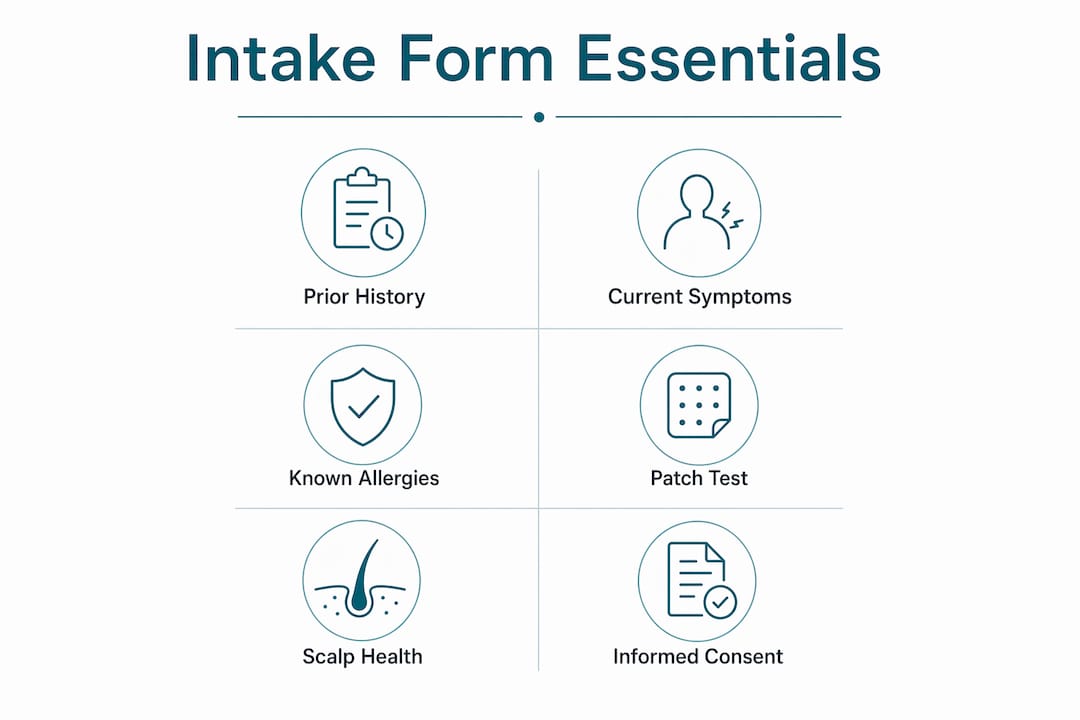
5. Scalp health context and chemical dependency
Some clients arrive with underlying scalp conditions that make chemical services high-risk regardless of allergy status. Understanding scalp conditions and chemical dependency helps you identify clients who need a modified approach or a referral before any chemical service begins.
6. Informed consent with treatment plan details
The final section of the form documents that the client understands the risks, has disclosed all relevant health information, and agrees to the proposed treatment plan. Client consultations function as both risk assessment tools and legal records documenting health history, contraindications, and informed consent. A signed consent section transforms your intake form into a legal document.
Pro Tip: Add a field asking clients to rate current scalp sensitivity on a scale of 1 to 10. Clients who score 7 or above should receive a patch test regardless of prior service history.
How to design intake forms that comply with 2026 US regulations
Compliance is not optional. Under the Modernization of Cosmetics Regulation Act (MoCRA), beauty professionals operating in the US must meet specific recordkeeping standards. Here is how to build forms that satisfy both regulatory requirements and professional best practices.
-
Retain records for the correct duration. Adverse-event records under MoCRA must be kept for six years by standard businesses and three years by small businesses. Date-stamp every form at the point of collection. This single habit makes your records audit-ready without additional effort.
-
Include health screening questions aligned with Cosmetology Authority guidance. The client consultation best practices framework recommends capturing health data and client agreement before chemical, thermal, or manipulative services. Your form should mirror this structure: health history first, contraindication screening second, consent last.
-
Separate the intake section from the consent section. Combining health questions and legal consent language on one page creates confusion. Clients skim and miss critical disclosures. Use two clearly labeled sections so clients read each part with full attention.
-
Use digital forms with date and time stamps. Paper forms get lost, misfiled, or damaged. Digital intake forms create automatic audit trails. Organized, date-stamped records enable salons to be inspection-ready under evolving cosmetics regulations. This is not a luxury. It is a practical compliance requirement.
-
Review your forms annually. Regulations change. Product formulations change. A form built in 2023 may not capture the allergens or disclosures required in 2026. Schedule a form review every January.
“Consultation forms are simultaneously client safety tools and legal evidence of disclosure, critical in high-risk chemical services.”: Cosmetology Authority
Step-by-step process to collect and act on intake data
Collecting the form is only half the job. Acting on the data is where safety and treatment efficacy are actually determined.
-
Send the form before the appointment. Clients who complete intake forms at home provide more accurate answers than clients filling them out in a busy reception area. Use a digital form sent 24 to 48 hours before the appointment. This also gives you time to review responses and flag concerns before the client arrives. Sending intake forms before appointments is a proven practice for better preparation and safer service delivery.
-
Review for contraindications before the client sits in your chair. Look specifically for recent chemical services within the past four weeks, active scalp symptoms, PPD allergy history, and any medications that affect skin sensitivity. If you see a red flag, prepare your questions before the consultation begins.
-
Determine patch test requirements. Patch testing for oxidative dyes 24 to 48 hours before treatment is the professional standard for identifying allergic reactions. If the client’s form shows a prior reaction, no patch test on record, or a new product being used, a patch test is mandatory. Do not skip this step under time pressure.
-
Document the treatment plan alongside the consent. After reviewing the intake data and completing any required patch testing, write the agreed treatment plan directly on the consent form. Include the products used, processing times, and any modifications made based on the client’s health history. This creates a complete service record.
-
Update records for repeat clients. A returning client’s health status changes. Medications change. Scalp conditions develop. Ask every repeat client to confirm or update their intake information at each visit. A form completed 18 months ago does not reflect today’s client.
Pro Tip: Build a “last updated” date field into your digital form template. Set a rule that any form older than six months triggers an automatic update request before the next appointment is confirmed.
Common mistakes in chemical treatment intake forms
Even experienced professionals make intake form errors that create safety gaps and compliance risks. These are the most common ones.
-
Asking about allergies without naming specific allergens. “Do you have any allergies?” is not a useful question for chemical services. Ask specifically about PPD, resorcinol, formaldehyde, and persulfates. Detailed allergy and patch test history converts intake from a checkbox exercise into real safety screening. Clients who do not know the chemical name of their allergen will answer “no” to a generic question.
-
Ignoring current scalp symptoms in favor of past diagnoses. A client may have no diagnosed scalp condition but arrive with active irritation. Intake forms should capture present symptoms rather than just past diagnoses to inform safe treatment decisions. Redness or tenderness present on the day of service is a more relevant data point than a condition diagnosed two years ago.
-
Discarding forms after the service is complete. This is a direct compliance violation under MoCRA. Adverse event records must be retained for up to six years. Even if no adverse event occurred, retaining signed consent forms protects you if a client later claims they were not informed of risks.
-
Using the same form for every chemical service. A skin treatment questionnaire for a chemical peel requires different questions than an intake form for scalp treatments involving relaxers or color. Tailor your forms to the specific service category.
-
Failing to explain the form to the client. Clients who do not understand why you are asking certain questions may skip sections or answer inaccurately. A brief verbal explanation at intake increases form accuracy and builds client trust.
Key takeaways
A complete, well-designed intake form for chemical treatments is the single most effective tool for preventing adverse reactions, meeting MoCRA compliance standards, and protecting your salon from liability.
| Point | Details |
|---|---|
| Capture current symptoms | Use symptom checkboxes for present scalp and skin conditions, not just past diagnoses. |
| Name specific allergens | Ask about PPD, resorcinol, and formaldehyde by name to get accurate allergy history. |
| Retain records correctly | Keep adverse-event and consent records for six years under MoCRA requirements. |
| Send forms before appointments | Pre-appointment digital forms produce more accurate client responses and flag contraindications early. |
| Update forms at every visit | Repeat clients must confirm or revise their health information before each chemical service. |
Why intake forms are the most underused safety tool in salons
I have reviewed intake processes at dozens of salons over the years, and the pattern is consistent. The salons with the fewest adverse event incidents and the strongest client retention are not the ones with the most expensive equipment or the most advanced techniques. They are the ones with the most disciplined intake processes.
What surprises most professionals is how much client trust a thorough intake form builds. Clients who are asked detailed, specific questions about their scalp health, medication history, and prior reactions feel seen. They feel that you are taking their safety seriously. That perception translates directly into loyalty and referrals.
The mistake I see most often is treating the intake form as a legal formality rather than a clinical tool. When you read a client’s form before they sit down, you walk into the consultation already knowing their contraindications, their concerns, and their history. That preparation changes the quality of the conversation and the quality of the service.
One more thing worth saying directly: the role of consent forms in beauty treatments extends beyond liability protection. A signed, detailed consent form tells your client that you operate at a professional standard. That signal matters more than most salon owners realize.
— Artur
How Getconsentify helps salons build better intake forms
Getconsentify builds digital intake forms specifically designed for beauty and wellness professionals. The platform lets you create branded, customizable pre-treatment assessment forms that capture chemical history, scalp symptoms, allergy screening, and signed consent in one clean client-facing flow. Forms are automatically date-stamped, securely stored, and retrievable for compliance audits. You can send them before appointments, collect responses on any device, and flag contraindications before the client arrives. If you are ready to replace paper forms and manual follow-up with a system built for salon compliance, explore Getconsentify’s beauty salon forms and see how quickly your intake process can improve.
FAQ
What is an intake form for chemical treatments?
An intake form for chemical treatments is a pre-service questionnaire that collects a client’s health history, scalp and skin condition, allergy status, and informed consent before any chemical salon procedure such as hair color, relaxers, or chemical peels.
What questions should a chemical treatment intake form include?
The form should ask about prior chemical services with dates, current scalp symptoms, known allergens including PPD and formaldehyde, current medications, prior adverse reactions, and patch test history. A signed consent section should follow the health screening questions.
How long must salons keep chemical treatment intake forms?
Under MoCRA, standard businesses must retain adverse-event cosmetic records for six years and small businesses for three years. Retaining all signed intake and consent forms for at least six years is the safest compliance practice.
When is a patch test required before a chemical service?
A patch test for oxidative dyes should be performed 24 to 48 hours before treatment whenever a client has a history of allergic reactions, has not been tested with the specific product before, or reports current scalp sensitivity. A positive patch test result contraindicates proceeding with that chemical service.
Can digital intake forms replace paper forms for compliance purposes?
Yes. Digital intake forms with automatic date and time stamps, secure storage, and audit trails meet MoCRA recordkeeping expectations and are generally more reliable than paper forms for long-term retention and inspection readiness.