Types of Spa Treatment Consent Forms: A Pro Guide
Discover the essential types of spa treatment consent forms and how to protect your practice. Learn the legal details and templates you need!

Types of Spa Treatment Consent Forms: A Pro Guide

Spa treatment consent forms are legally binding documents that authorize procedures, disclose risks, and protect both your practice and your clients before any service begins. The industry term is informed consent documentation, and it covers far more than a single signature page. Most spa professionals know they need forms. Far fewer understand that different form types serve distinct legal and operational functions. The American Med Spa Association maintains 19 separate informed consent forms across treatment categories, which signals exactly how granular this documentation needs to be. This guide breaks down every major form type, explains what each one does, and shows you how to build a documentation system that holds up legally.
1. Types of spa treatment consent forms every practice needs
The types of spa treatment consent forms fall into six primary categories. Each one addresses a different dimension of client authorization, risk disclosure, and legal compliance. Using all six creates the layered protection that legal experts and industry associations recommend.
Client intake and medical history forms are the foundation of every spa visit. These forms collect contact information, health conditions, current medications, allergies, and contraindications relevant to your services. For massage therapy, hybrid intake forms combine medical history with treatment consent in one document, which reduces paperwork without sacrificing legal coverage. The key is that the language must still be tailored to the specific treatment being performed.
Treatment-specific informed consent forms are the core of your legal protection. These documents outline the exact procedure, its known risks, potential side effects, and available alternatives. A botox consent form must address bruising, asymmetry, and rare neurotoxin migration. A microneedling form must cover infection risk, post-inflammatory hyperpigmentation, and healing timelines. A massage consent form addresses contraindications like blood clots or recent surgery. Generic language that attempts to cover all treatments in one document weakens enforceability and reduces genuine client understanding.

HIPAA and privacy notice acknowledgments apply whenever you collect, store, or share protected health information. If your spa performs any medical-adjacent services, including laser treatments, injectables, or clinical facials, HIPAA compliance is not optional. Clients must sign an acknowledgment confirming they received your Notice of Privacy Practices.
Photo and video consent forms grant your practice permission to capture and use client images. This is a separate document from treatment consent, and it requires explicit opt-in language rather than implied agreement.
Financial agreements and cancellation policies protect your revenue. These forms confirm the client’s understanding of deposit requirements, late cancellation fees, and refund policies. Signed financial agreements reduce disputes and give you documented recourse.
State-specific or specialized waivers address jurisdictional requirements or high-risk procedures. Some states require specific language for chemical peels, laser services, or injectables. These waivers supplement your standard forms rather than replace them.
Pro Tip: Review your state’s cosmetology or medical board regulations annually. Requirements for specific consent language change, and an outdated form can undermine an otherwise solid documentation package.
2. How spa treatment waiver forms differ from informed consent forms
These two document types are frequently confused, but they serve fundamentally different legal functions. Understanding the distinction protects you from relying on the wrong form in the wrong situation.
| Feature | Spa treatment waiver form | Informed consent form |
|---|---|---|
| Primary purpose | Limits spa liability for inherent risks | Documents client understanding of procedure-specific risks |
| Legal mechanism | Assumption of risk and liability release | Authorization based on disclosed information |
| Scope | Broad, covers general wellness services | Narrow, specific to one treatment or procedure |
| Client action | Acknowledges and accepts general risks | Actively agrees after reviewing detailed information |
| When required | Before any service, especially high-risk | Before each distinct treatment type |
A spa treatment liability release, like the guest waiver used by Spencer’s Spa, covers voluntary participation in wellness services and discloses common risks such as muscle soreness, skin irritation, and allergic reactions. It also limits liability for lost or stolen personal items. This type of document is broad by design. It does not describe a specific procedure or walk the client through treatment alternatives.
Informed consent, by contrast, is a process as much as a document. The client receives specific information about what will happen, what could go wrong, and what alternatives exist. They then sign to confirm they understood and agreed. Courts treat these two documents differently. A waiver that attempts to function as informed consent for a clinical procedure is likely to fail under scrutiny.
Pro Tip: Never use a general liability waiver as a substitute for procedure-specific informed consent. Carry both documents for every treatment category you offer.
3. Why procedure-specific forms outperform generic consent documents
Legal defensibility in med spas comes from an organized collection of intake forms, informed consents, policies, and standard operating procedures. A single all-purpose consent form cannot achieve this. Here is why procedure-specific forms are the professional standard:
-
Risk profiles vary dramatically by treatment. Botox carries risks of ptosis and neurotoxin spread. Laser resurfacing carries risks of burns, scarring, and pigmentation changes. Massage carries risks related to circulatory conditions and recent injuries. One form cannot accurately disclose all of these without becoming so broad that it communicates nothing clearly.
-
Client comprehension improves with focused documents. When a client reads a consent form that addresses only the treatment they are about to receive, they retain the information better and ask more relevant questions. A form covering 15 different procedures overwhelms and confuses.
-
Enforceability depends on specificity. Courts evaluating consent disputes look at whether the client was genuinely informed about the specific risks of the specific procedure. Generic forms undermine informed consent quality and can be challenged on the grounds that the client could not have understood what they were agreeing to.
-
Regulatory requirements are treatment-specific. Many states mandate particular disclosures for injectables, chemical peels, or laser services. A generic form cannot satisfy these requirements without becoming a patchwork document that satisfies none of them well.
-
Staff training becomes more effective. When your estheticians and therapists work with focused, treatment-specific forms, they can walk clients through the document confidently and answer questions accurately. A sprawling generic form creates uncertainty for staff and clients alike.
4. How to manage photo and marketing consent forms separately
Photo consent is one of the most mishandled areas of spa documentation. Many practices assume that a general consent form covers photography. It does not. Implied photographic consent is legally weak, and relying on it exposes your practice to privacy complaints and potential regulatory action.
Best practice requires a dedicated photo and marketing consent form with explicit opt-in checkboxes for each level of use. The mailbaze 2026 consent template structures this with the following options:
- No consent: Client declines all photography for marketing purposes.
- Anonymized use: Images may be used with no identifying features visible.
- Limited identification: Images may be used in specific contexts with partial identification.
- Full marketing consent: Client authorizes use across all marketing channels including social media, website, and print.
Each option requires a separate initial or checkbox. This structure respects client autonomy, reduces the risk of privacy disputes, and gives your marketing team clear guidance on what they can use. Clients who feel their privacy preferences are respected are more likely to grant broader permissions. Clients who feel pressured or unclear about what they are signing tend to revoke consent later or raise complaints.
Separate photo consent also makes record-keeping cleaner. When a client updates their preferences, you update one document rather than reissuing an entire consent package.
5. Choosing and implementing the right forms for your spa
Building a compliant consent documentation system requires more than downloading templates. You need to match your forms to your specific services, your state’s regulatory requirements, and your client communication style.
Start with your treatment menu. Every distinct service category needs its own informed consent form. If you offer massage, facials, chemical peels, laser treatments, and injectables, that is five separate consent documents at minimum. The American Med Spa Association’s library includes 19 informed consent forms, 11 intake forms, and 24 treatment standard operating procedures, which gives you a benchmark for how comprehensive a well-run practice’s documentation should be.
Check your state’s cosmetology board, medical board, and any applicable health department regulations before finalizing your forms. Some states require specific disclosure language for certain procedures. Others mandate that forms be provided in the client’s primary language. Ignoring these requirements creates compliance gaps that a template provider cannot fix for you.
Update your forms whenever you add a new service, change a procedure protocol, or when relevant laws change. A consent form that accurately described your chemical peel protocol two years ago may not reflect your current products or techniques. Outdated forms are a liability, not a protection.
Train your staff to treat consent as a conversation, not a formality. The massage consultation form approach works well precisely because it combines intake and consent in a way that prompts a real discussion about contraindications and client health. Your front desk team and treatment providers should be able to explain every section of every form they hand to a client.
Store all signed forms securely. If your services fall under HIPAA, digital storage must meet HIPAA security standards. Even for non-HIPAA services, secure storage protects you in the event of a dispute.
Pro Tip: Audit your consent documentation package every 12 months. Compare your forms against your current treatment menu and check for any regulatory updates in your state. Schedule this review the same way you schedule equipment maintenance.
Key takeaways
A complete spa consent documentation system requires distinct forms for each treatment category, not one generic document covering all services.
| Point | Details |
|---|---|
| Use multiple form types | Intake, treatment consent, HIPAA acknowledgment, photo release, and financial agreements each serve a different legal function. |
| Waivers and consent differ | A liability waiver covers general risk assumption; informed consent documents procedure-specific risks and client authorization. |
| Procedure-specific forms win | Tailored forms improve client comprehension, satisfy regulatory requirements, and hold up better in legal disputes. |
| Photo consent needs explicit opt-in | Separate photo release forms with checkbox options for each use level protect client privacy and your marketing rights. |
| Review forms annually | Outdated forms create compliance gaps; align documentation with your current treatment menu and state regulations every year. |
Why consent forms deserve more strategic attention than most spas give them
I have reviewed documentation packages from dozens of spa and med spa practices over the years, and the pattern is consistent. Most practices have some forms. Very few have the right forms, structured correctly, for every service they offer. The gap between those two situations is where liability lives.
The most common mistake I see is treating consent documentation as a one-time setup task. A practice launches, downloads a few templates, and never revisits them. Two years later, they have added three new services, changed their chemical peel protocol, and hired staff who have never been trained on what the forms actually say. That is not a documentation system. That is a false sense of security.
The second most common mistake is conflating the waiver with informed consent. A guest liability waiver serves a real purpose. It establishes voluntary participation and covers inherent risks of wellness services. But it does not replace the obligation to inform a client specifically about what a microneedling session involves, what can go wrong, and what alternatives exist. These are two different documents doing two different jobs.
What I have found actually works is treating your consent documentation package the same way you treat your treatment menu. It is a living system that gets updated, refined, and communicated to your team regularly. When staff understand the purpose of each form and can explain it to clients confidently, consent stops feeling like a legal hurdle and starts functioning as a genuine part of the client experience. Clients who feel informed trust you more. That trust is worth protecting.
— Artur
How Getconsentify simplifies your spa consent documentation
Managing multiple consent form types across a growing treatment menu is a real operational challenge. Getconsentify is a digital consent platform built specifically for clinics and beauty and wellness businesses. It gives you customizable templates for every form type covered in this article, from client intake and treatment-specific informed consent to HIPAA acknowledgments and photo release forms.
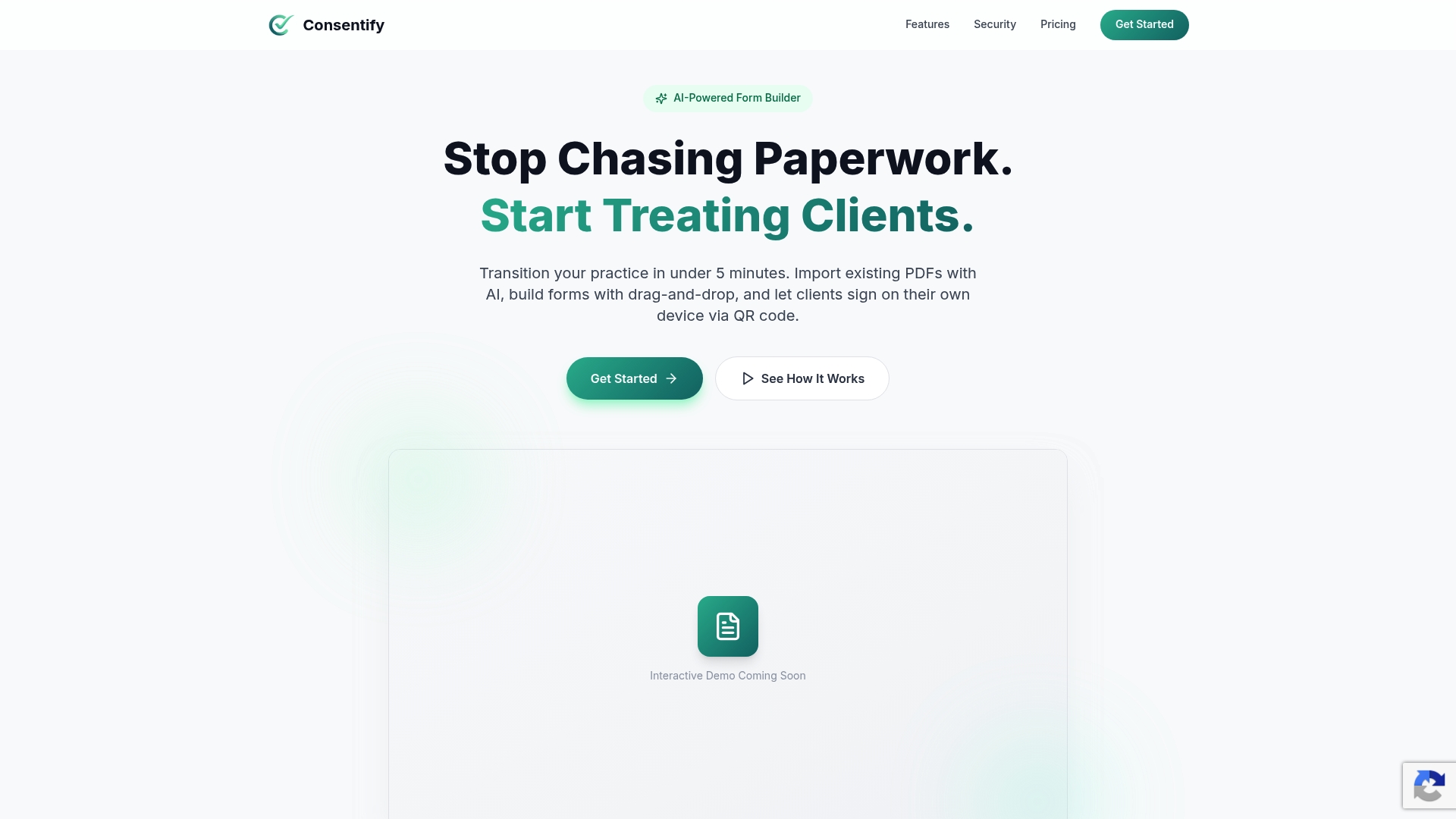
Clients sign digitally before their appointment, forms are stored securely, and your team has instant access to completed documentation. No paper chasing, no missing signatures, no compliance gaps. If you are ready to build a documentation system that actually protects your practice, explore Getconsentify’s digital forms and see how fast you can get every form type in place.
FAQ
What are the main types of spa consent forms?
The main types are client intake and medical history forms, treatment-specific informed consent forms, HIPAA and privacy acknowledgments, photo and marketing consent forms, financial agreements, and state-specific liability waivers. Each serves a distinct legal and operational function.
Can I use one generic consent form for all spa treatments?
No. Generic all-in-one forms undermine informed consent quality because they cannot accurately disclose the specific risks of each treatment. Procedure-specific forms are the professional and legal standard.
Can I refuse a spa treatment if I haven’t signed a consent form?
Yes. Clients have the right to decline any treatment at any time, including before signing documentation. The consent process is voluntary, and a client’s refusal to sign means the treatment should not proceed.
How often should spa consent forms be updated?
Consent forms should be reviewed and updated at least once a year, or whenever you add a new service, change a treatment protocol, or when state regulations change. Outdated forms can create compliance gaps even if they were accurate when originally written.
Do spa photo consent forms need to be separate from treatment consent?
Yes. Separate photo consent forms with explicit opt-in checkboxes for each level of marketing use are best practice. Implied consent from a general treatment form is legally weak and does not give clients meaningful control over how their images are used.