Spray Tan Consent Form: What Clients and Salons Need to Know
Learn what a spray tan consent form is and why it protects both clients and salons. Essential for safe and legal sunless tanning!

Spray Tan Consent Form: What Clients and Salons Need to Know

A spray tan consent form is a signed legal document that records a client’s health disclosures, confirms understanding of risks, and provides liability protection for spray tan businesses. Known in the industry as a client release form or spray tan waiver form, this document is a non-negotiable part of professional sunless tanning services. The FDA has approved DHA for external topical use but not for spray mist inhalation, which makes written safety acknowledgment a clinical and legal necessity. Salons that skip this step face insurance gaps, disputes, and potential legal exposure.
What is a spray tan consent form and what does it include?
A spray tan consent form is a legally important document that collects client health data and secures a liability waiver limiting the salon’s responsibility for typical spray tan risks. It covers everything from medical history to post-tan care. Think of it as the written record that proves both parties understood the service before it began.
A complete spray tan client information form typically includes the following elements:
- Client personal details: Full name, contact information, and date of birth.
- Medical and skin health disclosures: Known allergies, current medications, skin conditions such as eczema or psoriasis, and pregnancy status.
- Pre-tan preparation instructions: Exfoliation requirements, avoidance of lotions and deodorants, and clothing guidance.
- Post-tan care instructions: Water avoidance windows, moisturizing schedules, and activity restrictions.
- DHA safety acknowledgment: A note that DHA requires protective measures during application, including nose plugs, eye covers, and lip balm to prevent inhalation or mucous membrane exposure.
- Liability waiver language: A clear statement that the client accepts the ordinary risks of spray tanning.
- Signature and date: Client signature, plus guardian and witness signatures when the client is a minor.
Pro Tip: Keep your intake form and your consent form as two separate documents. Separating intake and consent forms improves risk management by clearly distinguishing health screening from legal acknowledgment. One form does a health job; the other does a legal job.
Professional studios also include expected tan color, estimated longevity, and a note about scheduling first-time tans away from major events. That last detail matters more than most clients realize.

Why is a spray tan consent form legally important?
A spray tan liability agreement protects the salon and the client by creating a documented record of informed consent. Without it, a salon has no proof the client understood the risks before the session began. Courts and insurers treat that gap as a serious problem.
Here are the four core legal functions these forms serve:
- Documenting informed consent. The form proves the client received and acknowledged safety information, including DHA cautions and contraindications. That documentation is the foundation of any liability defense.
- Limiting liability for ordinary risks. A properly written waiver limits the salon’s exposure to typical adverse reactions such as skin irritation or uneven color. Liability waivers protect against ordinary risks but do not shield salons from gross negligence or misconduct.
- Authorizing services for minors. Clients must complete a consent form before every session, and minors require a parent or guardian signature plus a witness for legal authorization. Skipping this step creates direct legal exposure.
- Supporting insurance compliance. Failure to collect signed consent forms can invalidate insurance coverage and expose salons to greater liability. Insurers treat unsigned or missing forms as evidence of negligent intake practices.
“While waivers limit liability for normal risks, salons must maintain all safety protocols to avoid claims of negligence.”: Legal professionals consistently reinforce this point when advising beauty businesses on risk management.
Salons should review their forms at least once a year. Product formulations change, FDA guidance evolves, and state regulations shift. An outdated form may not reflect current safety standards, which weakens its legal standing.
How do spray tan consent forms support client safety?
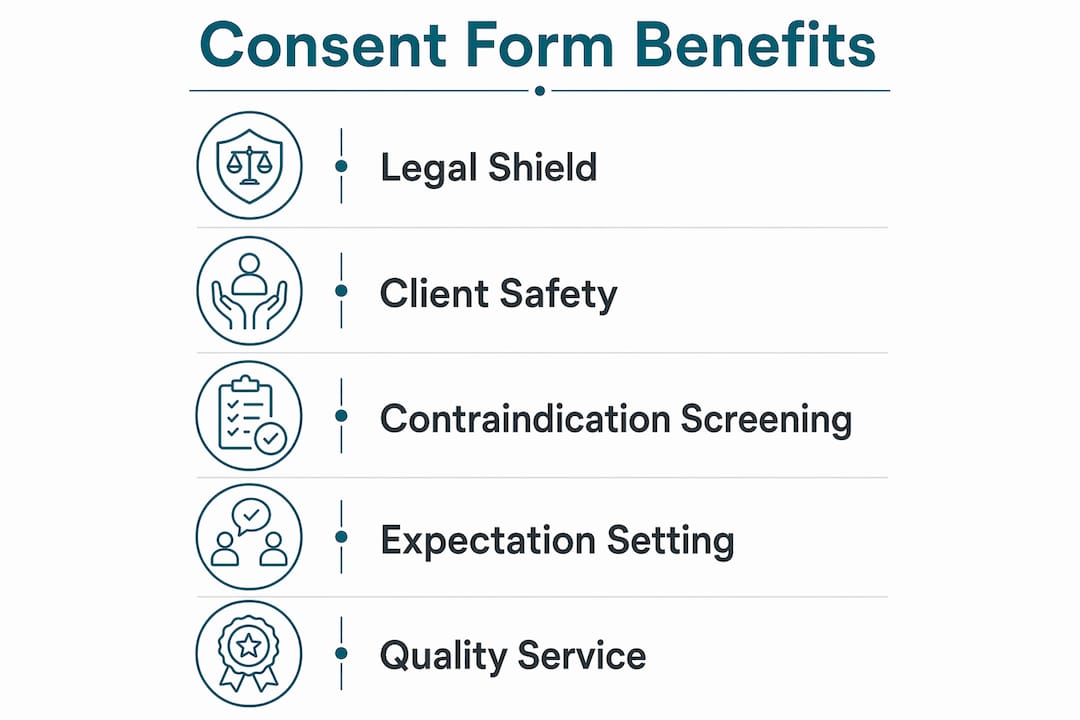
A well-designed consent form does more than satisfy legal requirements. It actively improves the quality and safety of the service. The form functions as a pre-session screening tool that catches contraindications before they become problems.
Screening for contraindications
The health disclosure section identifies clients who may react badly to DHA. Conditions like active eczema, open wounds, or recent chemical peels all increase the risk of irritation. A thorough health screening intake form lets the technician adjust the application or recommend a patch test before proceeding.
Setting realistic expectations
The form communicates what the client should expect: how long the tan lasts, how dark it will develop, and what factors affect the result. Clients who read this information before their session are far less likely to be dissatisfied afterward. Experts recommend advising clients against booking a first-ever spray tan right before a wedding, graduation, or major event. An unexpected reaction or uneven result on a high-stakes day creates a dispute that no waiver fully resolves.
Pro Tip: Use the post-tan care section of your consent form as a client education tool, not just a legal checkbox. Clients who follow aftercare instructions get better results and leave better reviews.
| Form element | Client safety benefit |
|---|---|
| Medical history disclosure | Identifies contraindications before application |
| DHA safety acknowledgment | Ensures client understands inhalation and eye exposure risks |
| Pre-tan prep instructions | Reduces uneven results from lotions or recent waxing |
| Post-tan care instructions | Extends tan longevity and reduces skin irritation |
| Event scheduling advisory | Prevents dissatisfaction from first-session unpredictability |
Separating the intake form from the consent form also improves the client experience. The intake form focuses entirely on health and skin history. The consent form focuses on legal acknowledgment. Clients find this clearer, and technicians find it easier to reference during the session.
Best practices for salons implementing spray tan consent forms
Collecting a signed form once and filing it away is not enough. Effective consent management is an ongoing practice, not a one-time setup.
- Collect a new form before every session. Clients’ health status, medications, and skin conditions change. A form signed six months ago may not reflect current contraindications.
- Store records securely. Paper forms get lost, damaged, or accessed by unauthorized staff. Digital storage with access controls protects both client privacy and salon liability.
- Use digital forms to reduce friction. Digital consent form tools improve management efficiency, support compliance, and enhance client communication in beauty and wellness businesses. Clients complete forms on their own devices before arriving, which cuts wait times and eliminates illegible handwriting.
- Train staff to explain forms clearly. A client who feels rushed through a signature is more likely to dispute a result later. Staff should be able to answer basic questions about DHA, aftercare, and what the waiver covers.
- Include proper minor consent protocols. For clients under 18, parental consent and witness signatures are a legal requirement in most jurisdictions. Build this into your intake workflow so it never gets skipped.
- Review and update forms annually. Product lines change, and so do local regulations. An annual review keeps your forms legally current and professionally credible.
The salons that handle consent management best treat it as part of their service quality, not as a compliance burden. Clients notice when a salon takes their health seriously before the session even starts.
Key takeaways
A spray tan consent form is both a legal shield and a client safety tool. Salons that treat it as a formality miss its full value.
| Point | Details |
|---|---|
| Core definition | A spray tan consent form records health disclosures, risk acknowledgment, and liability protection in one signed document. |
| Legal protection limits | Waivers cover ordinary risks but do not protect salons from gross negligence or missing safety protocols. |
| Separate your forms | Use one form for health intake and a separate form for legal consent to improve clarity and risk management. |
| Minor client requirements | Clients under 18 require a parent or guardian signature plus a witness for the form to be legally valid. |
| Digital management wins | Digital forms reduce errors, improve record security, and make compliance easier to maintain across sessions. |
Why consent forms deserve more respect than they get
Most technicians I’ve spoken with treat the consent form as the paperwork before the real work begins. That framing is wrong, and it costs salons money.
The form is the first professional interaction a client has with your business. A clear, well-organized consent document signals that you take safety seriously. A crumpled paper form with tiny print signals the opposite. Clients read that signal before the spray gun ever touches their skin.
The detail I find most overlooked is the separation of intake and consent forms. Salons that combine everything into one dense document create confusion. The client doesn’t know if they’re disclosing health information or signing away rights. Keeping those two functions separate makes both documents stronger and the client more confident in what they’re agreeing to.
The other thing salons consistently underestimate is the insurance angle. Missing or unsigned forms don’t just create legal risk in a courtroom. They create risk at the claims stage, before you ever get to court. An insurer who sees no signed consent form on file has grounds to deny a claim outright. That is a concrete, immediate financial consequence that most salon owners don’t think about until it happens to them.
Digital consent management changes this entirely. When forms are collected, signed, and stored automatically before every session, the compliance gap closes. The salon’s records are always current, always accessible, and always defensible.
— Artur
Consentify makes spray tan consent management simple
Running a spray tan business means focusing on your clients, not chasing down paperwork.
Consentify replaces paper consent forms with branded digital documents that clients complete on their own devices via QR code. The platform converts your existing PDFs into editable digital forms with AI, stores signed records with military-grade encryption, and maintains tamper-proof audit logs for every session. For salons managing beauty and wellness consent forms, Consentify handles minor consent workflows, multi-language support, and before-and-after photo capture in one place. Your forms are always current, always signed, and always on file when you need them.
FAQ
What is a spray tan consent form?
A spray tan consent form is a signed document that records a client’s health disclosures, confirms understanding of DHA risks, and provides a liability waiver protecting the salon against ordinary adverse reactions.
Do I need a spray tan consent form for every session?
Yes. Clients should complete a consent form before every spray tan session because health conditions and medications change between visits. Minors require a parent or guardian signature plus a witness.
What does a spray tan waiver form protect against?
A spray tan waiver form limits the salon’s liability for typical risks such as skin irritation or uneven color. It does not protect against gross negligence or failure to follow safety protocols.
Is DHA in spray tans FDA approved?
The FDA has approved DHA for external topical use but not specifically for spray mist application due to inhalation concerns. Consent forms should note this and document that protective gear was offered to the client.
Should intake and consent forms be separate documents?
Yes. Separating the health intake form from the legal consent form improves risk management and client clarity. The intake form handles health screening; the consent form handles legal acknowledgment.