Secure Client Signatures on Tattoo Waivers: Your Guide
Learn how to ensure secure client signatures on tattoo waivers. Protect your rights with tamper-proof technology and legal assurance.

Secure Client Signatures on Tattoo Waivers: Your Guide

A secure client signature on a tattoo waiver is legally binding only when it links your identity to your consent, captures tamper-proof metadata, and is stored with proper encryption. The U.S. ESIGN Act and the Uniform Electronic Transactions Act (UETA) set the baseline: a valid digital waiver must prove who signed, what they agreed to, and that the document was never altered. As a client, understanding what makes a secure client signature on a tattoo waiver enforceable protects your rights and gives you confidence before you sit in the chair. Platforms like Consentify meet these standards through military-grade encryption and tamper-proof audit logs.
What makes a secure client signature on a tattoo waiver legally valid?
A legally valid electronic signature on a tattoo waiver requires three things: proof of intent, identity linkage, and a tamper-evident record. The ESIGN Act and UETA both confirm that digital signatures carry the same legal weight as handwritten ones, provided these conditions are met. Skipping any one of them weakens the waiver’s defensibility in court.
Intent means you actively chose to sign. Clicking a button labeled “I agree” or drawing your signature on a touchscreen both satisfy this requirement. Passive checkboxes or pre-filled signatures do not.

Identity linkage is where most paper-based and basic digital systems fall short. Simply typing your name into a text field does not prove you were the one who typed it. Strong systems use email or SMS verification during the signing process to create a robust legal connection between the signature and the signer. Device fingerprinting goes further, capturing your browser type, IP address, operating system, and geolocation at the exact moment of signing.
Tamper-evident storage means the document cannot be changed after you sign it without that change being detected. Cryptographic timestamps lock the document’s state at the moment of signing. Any alteration after that point breaks the cryptographic seal and flags the record as compromised.
Here is what a technically sound signature record should include:
- Your IP address at the time of signing
- A device fingerprint (browser, OS, screen resolution)
- A cryptographically verifiable timestamp
- An email or SMS verification token confirming your identity
- An immutable audit trail showing every access event after signing
In Europe, the eIDAS regulation sets equivalent standards for electronic signatures. If you are a client at a studio operating under European data protection rules, your waiver must also comply with GDPR requirements for explicit consent on sensitive personal data.
Pro Tip: Ask the studio to send you a copy of your signed waiver immediately after signing. A legitimate platform will do this automatically. If they cannot, that is a signal the system lacks proper audit trail functionality.
How are digital tattoo waivers securely collected and stored?
Secure collection starts before you ever pick up a stylus. A well-built system sends you a waiver link or QR code tied directly to your appointment, so the signed form is automatically connected to your booking record. Workflow integration with booking systems eliminates the most common failure point: a session that starts without a completed, time-stamped consent form on file.
The collection process works in four steps:
- Appointment booking triggers the waiver. The studio’s system sends you a unique link via email or SMS. That link is tied to your specific appointment, not a generic form.
- You verify your identity. You confirm via email or SMS before the form opens. This step creates the legal link between you and the signature.
- You complete and sign the form. The platform captures your device fingerprint, IP address, and a cryptographic timestamp the moment you submit.
- The signed record is stored securely. The document moves into encrypted storage immediately. You receive a copy, and the studio’s system logs the event in an immutable audit trail.
Once stored, the security of your data depends on two encryption standards:
| Storage stage | Encryption standard | What it protects |
|---|---|---|
| Data in transit | TLS (Transport Layer Security) | Prevents interception while data moves to the server |
| Data at rest | AES-256 | Protects stored files from unauthorized access |
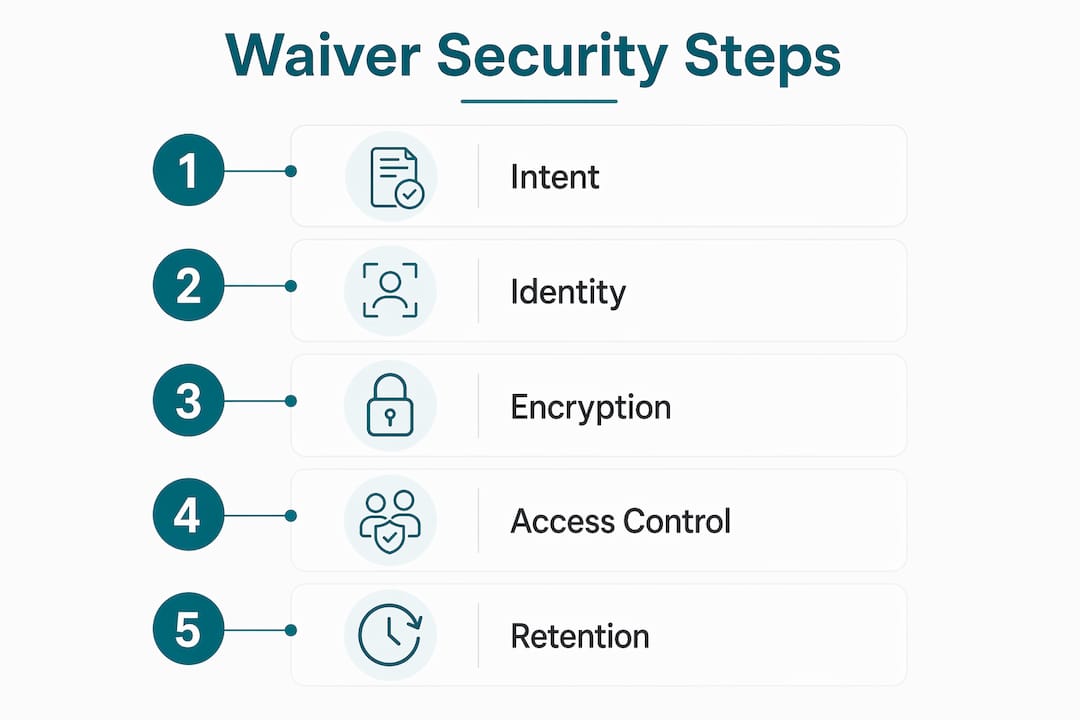
TLS and AES-256 encryption are the same standards used by financial institutions and healthcare providers. Their use in tattoo waiver platforms is not optional if the studio handles sensitive health disclosures.
Role-based access controls add another layer. Only authorized staff should be able to view your signed waiver. A front-desk receptionist does not need access to your medical history. Proper systems restrict access by role, reducing the chance of accidental exposure.
Retention periods vary by state. New York requires studios to keep consent forms for 1 year, Texas and Hawaii for 2 years, Maryland for 3 years, Kansas and Nebraska for 5 years, and New Hampshire for up to 7 years. Automated retention policies treat these as minimums and schedule secure deletion when the period expires.
Pro Tip: Before your appointment, ask the studio which encryption standard they use for stored records. If they cannot answer, your health data may not be adequately protected.
What client information is required and how is sensitive health data protected?
A properly structured tattoo waiver collects specific information for specific reasons. Every field should have a clear legal or safety purpose. Collecting more data than necessary increases your privacy risk without adding legal protection for either party.
The fields a secure waiver should include are:
- Full legal name and date of birth. These confirm your identity and verify you are of legal age to consent.
- Government ID verification. Some studios require a photo ID upload or ID number to strengthen identity linkage.
- Medical disclosures relevant to tattooing. This includes blood-thinning medications, bleeding disorders, diabetes, skin conditions, and known allergies to ink pigments or latex.
- Contraindications acknowledgment. You confirm you are not pregnant, immunocompromised, or under conditions that increase tattooing risk.
- Informed consent statement. You acknowledge the risks explained by the artist and agree to proceed.
Medical disclosures are classified as sensitive personal data under both GDPR and HIPAA-adjacent frameworks. Explicit consent is required before a studio can collect this information, and it must be encrypted in transit and at rest. The data minimization principle applies here: studios should collect only what is directly relevant to the service being performed.
Access to your health disclosures should be restricted to the artist performing your tattoo and any clinical staff involved in your care. Administrative staff should not have access to this section of your record. Consentify applies role-based access controls that enforce this separation automatically.
Common mistakes that undermine tattoo waiver security
Most waiver security failures are not the result of bad intentions. They come from outdated practices that studios have not updated to meet current legal standards.
“A slick digital form UI doesn’t guarantee legal compliance. Audit trails proving the document is unaltered and signed by the client are key for validity.”: Digital consent form guidance
The most common mistakes include:
- Generic, unverifiable signatures. A typed name or a simple checkbox with no identity verification attached is not legally defensible. It proves nothing about who actually signed.
- Storing waivers in shared folders without audit logs. Shared PDF folders without immutable access logs fail basic security standards. Anyone with folder access can view, copy, or delete records without detection.
- Failing to link waivers to specific appointments. A waiver that is not tied to a booking record creates ambiguity. If a dispute arises, the studio cannot prove which session the consent covered.
- No encryption on stored health data. Saving signed forms as unencrypted PDFs on a local drive or cloud folder exposes your medical disclosures to anyone who gains access to that storage location.
- No retention or deletion policy. Keeping your data indefinitely beyond the required period increases liability for both you and the studio. Automated deletion after the mandated period is the correct approach.
As a client, you can protect yourself by asking one direct question before signing: “Can you show me where my signed waiver is stored and who can access it?” A studio with proper systems will answer confidently.
How to verify and maintain your signed tattoo waiver as a client
Once you have signed, you have the right to confirm your waiver is properly secured. Follow these steps:
- Request a copy immediately after signing. A secure platform sends this automatically. If you do not receive one, ask for it before your session begins.
- Check the metadata in your copy. Your copy should show the date, time, and a reference number. Some platforms include a verification link that lets you confirm the document has not been altered since signing.
- Confirm the retention period. Ask the studio how long they keep your record and under what state law. Cross-reference this with your state’s requirement for tattoo consent retention.
- Know your right to access. Under GDPR (for European clients) and various U.S. state privacy laws, you have the right to request a copy of your data at any time. Under some laws, you can also request deletion after the mandatory retention period expires.
- Verify the deletion protocol. Ask when your data will be deleted and how. Secure deletion means the file is overwritten, not just moved to a trash folder.
Your signed waiver is a legal document that protects you as much as it protects the studio. Treat it with the same care you would give a medical record.
Key takeaways
A secure tattoo waiver signature is only legally valid when it links your verified identity to a tamper-proof, encrypted record stored under a defined retention policy.
| Point | Details |
|---|---|
| Legal validity requires identity linkage | ESIGN and UETA require intent, identity verification, and tamper-evident storage for a defensible signature. |
| Encryption protects your health data | TLS covers data in transit; AES-256 protects stored records containing sensitive medical disclosures. |
| Retention periods vary by state | Requirements range from 1 year in New York to 7 years in New Hampshire; automated policies reduce compliance risk. |
| Audit trails matter more than signature images | A cryptographic audit trail proving the document is unaltered is the core of legal defensibility. |
| You have the right to verify your record | Request a copy immediately after signing and confirm the studio’s access controls and deletion schedule. |
Why I think clients underestimate their role in waiver security
Most clients treat the waiver as a formality. You sign it, hand back the tablet, and move on. That mindset is the single biggest gap in tattoo waiver security, and it is entirely fixable.
After years of working with consent workflows across client-facing industries, I have seen the same pattern repeat. Studios invest in a digital form tool, but clients never ask a single question about where their data goes. The result is that even a well-built system gets used carelessly, because no one on either side of the table is holding it accountable.
The studios that handle this best are the ones that treat the signing moment as a conversation, not a checkbox. They explain what the form captures, why identity verification is required, and how long the record is kept. That transparency builds genuine trust. It also pushes studios to use platforms that can actually answer those questions, which raises the standard for everyone.
My honest take: the best thing you can do as a client is ask two questions before you sign. First, “Who can access my health disclosures?” Second, “How will you delete my data when the retention period ends?” If the studio cannot answer both clearly, your data is not as secure as it should be. A platform like Consentify is built to answer both questions with specifics, not vague reassurances.
— Artur
Consentify’s digital tattoo waiver platform
Tattoo clients deserve more than a PDF in a shared folder. Consentify gives studios a fully compliant digital waiver platform built specifically for tattoo and piercing environments, with identity verification, AES-256 encrypted storage, and immutable audit trails included by default.
Clients sign on their own device via QR code, receive an automatic copy, and have their record linked directly to their appointment. Studios get a complete, time-stamped consent file before the session begins. Consentify also handles multi-language forms and integrates with existing booking systems, so no session starts without a fully secured consent on file. Your rights are protected from the moment you sign.
FAQ
What makes a digital tattoo waiver legally valid?
A digital tattoo waiver is legally valid under the U.S. ESIGN Act and UETA when it captures signer intent, links the signature to a verified identity, and stores a tamper-evident record with a cryptographic timestamp.
How long does a tattoo studio keep my signed waiver?
Retention periods vary by state, ranging from 1 year in New York to 7 years in New Hampshire. Studios should follow their state’s minimum requirement and use automated deletion once that period expires.
What encryption should protect my tattoo waiver data?
Your data should be protected by TLS during transmission and AES-256 encryption when stored. These are the same standards used in healthcare and financial services.
Can I request a copy of my signed tattoo waiver?
Yes. A secure platform sends you a copy automatically after signing. You can also request your record at any time under applicable state privacy laws or GDPR if you are in Europe.
What is the biggest security risk with digital tattoo waivers?
The most common risk is storing signed waivers in shared folders without audit logs or role-based access controls. This exposes your health data to anyone with folder access and removes the legal defensibility of the record.