How to Start a Beauty Business: The Complete 2026 Checklist
Thinking about starting a beauty business or opening your own salon? Here's the full checklist: licenses, insurance, equipment, plus the two steps new owners forget: client intake forms and data protection.
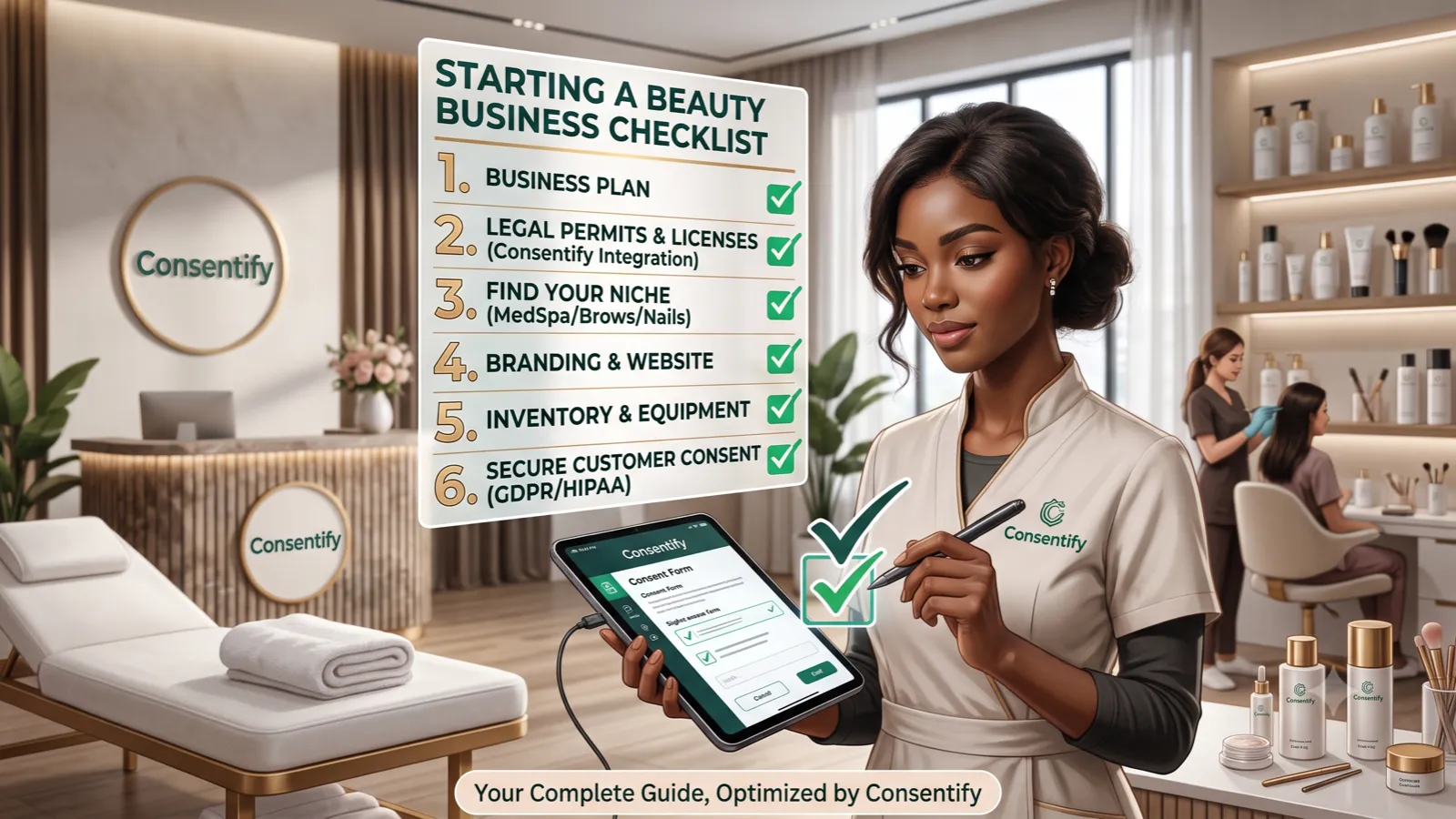
You've got the skills, the vision, and maybe even the perfect space picked out. But between the dream and opening day sits a checklist that trips up almost every new owner, and two of its most important items are the ones nobody talks about at beauty school: client paperwork and data protection. This guide walks through the whole checklist, whether you're opening a salon, a lash or brow studio, a tattoo shop, a massage practice, or a spray tan business.
Step 1: Choose your niche and write a one-page plan
You don't need a 40-page business plan, but you do need clear answers to four questions: What services will you offer? Who is your ideal client? What will you charge? And what does it cost you to deliver each service (products, time, rent share)? Price from your costs up, not from what the salon down the street charges.
Step 2: Make it legal, structure, licenses, and permits
- Business structure. Most solo owners start as an LLC: it separates your personal assets from the business and is inexpensive to set up in most states.
- Professional licenses. Cosmetology, esthetics, nail tech, massage therapy, and tattoo/body-art licenses are state-regulated. Your license usually must be displayed at your station.
- Local permits. Business license, health department inspection (mandatory for tattoo and piercing studios in nearly every state, and common for salons and spas), and a certificate of occupancy for your space.
- An EIN from the IRS: free, takes five minutes, and you'll need it for banking and taxes.
Step 3: Get insured before your first client
Two policies matter most: general liability (someone slips in your studio) and professional liability (a treatment causes a reaction or injury). Many landlords and booth-rental agreements require proof of both. If you hire staff, add workers' compensation.
Here's the part insurers don't advertise: when a claim actually happens, the first thing anyone asks for is documentation. Which brings us to the step most new owners skip.
Step 4: The paperwork that protects you: intake and consent forms
Every appointment where you touch a client, apply a product, or alter their appearance carries risk. A signed intake and consent form is your single best layer of protection, and in several industries it isn't optional:
- Tattoo & piercing studios: written informed consent is required by law in most states, often with age verification and specific health disclosures. Missing or incomplete consent forms are one of the most common findings in health department inspections.
- Massage practices: intake forms documenting health history, contraindications, and consent to treatment are required or strongly expected by state boards and insurers.
- Lash, brow, wax, and chemical services: patch-test acknowledgments and allergy disclosures are what stand between you and a "you never warned me" claim.
- Spray tan & sunless services: waivers covering skin conditions, medications that cause photosensitivity, and pregnancy are standard practice.
- Med spa–adjacent services: anything involving needles, acids, or heat should capture medical history and medication use (blood thinners, isotretinoin, and pregnancy are classic red flags).
A good intake form does three jobs at once: it screens for safety (allergies, medications, conditions that contraindicate the service), it documents informed consent (the client understood the risks and agreed), and it creates a defensible record with a signature and a timestamp. If a dispute ever lands on your insurer's desk, or a health inspector's clipboard, that record is what protects your license and your business.
Step 5: Protect your clients' data like the asset it is
The moment a client writes down their name, phone number, allergies, and medications, you're holding sensitive personal data: arguably health data. That comes with real obligations:
- Privacy laws apply to small businesses too. State privacy laws are expanding every year, and health-adjacent information is treated as sensitive in most of them. "I'm just a salon" is not an exemption.
- Paper is a liability. A binder of intake forms at the front desk can be photographed, misplaced, or taken. There's no access log, no way to prove who saw what, and no backup if there's a flood or fire.
- Retention matters. Consent forms are only useful if you can find them years later: claims often arrive long after the appointment.
The fix is the same whether you're a one-chair studio or a five-room spa: store client records digitally, encrypted, with access control and an audit trail. That means records survive anything that happens to your physical space, every view and edit is logged, and when a client asks what data you hold on them, you can actually answer.
Step 6: Go digital from day one
If you're starting fresh, you have an advantage every established salon envies: no paper to migrate. Set up digital intake before your first client and you'll never own a filing cabinet:
- Clients scan a QR code at the front desk or get a link the day before. They fill out and sign on their own phone, no app needed, before you've even mixed a color.
- Required fields can't be skipped, so you never discover a blank allergy section mid-service.
- Answers that need your attention (blood thinners, pregnancy, a retinoid prescription) can be flagged automatically before the treatment starts.
- Every signature is timestamped and every record is searchable in seconds, from the same device you run your day on.
Step 7: The rest of the launch list
- Business bank account + simple bookkeeping from day one
- Booking system and a card reader
- Instagram/TikTok presence with a Google Business profile (your real local-SEO engine)
- Supplier accounts and an opening inventory
- Before/after photo workflow: with photo consent captured on your intake form if you'll post client photos
The quick checklist
- ✔ Niche, pricing, and a one-page plan
- ✔ LLC, professional license, local permits, EIN
- ✔ General + professional liability insurance
- ✔ Intake & consent forms for every service you offer
- ✔ Encrypted digital storage for client records
- ✔ Booking, payments, bank account, socials
Most of this list is a one-time errand. The intake forms and client records, though, are part of every single appointment for the life of your business, which is why they're worth getting right on day one.
Consentify gives new beauty, tattoo, massage, and wellness businesses digital intake and consent forms in minutes: start from industry templates or import your own, let clients sign on their phones via QR code, and keep every record encrypted with a tamper-proof audit trail. The Essential plan is free. Set it up before your first client walks in. See how it works →